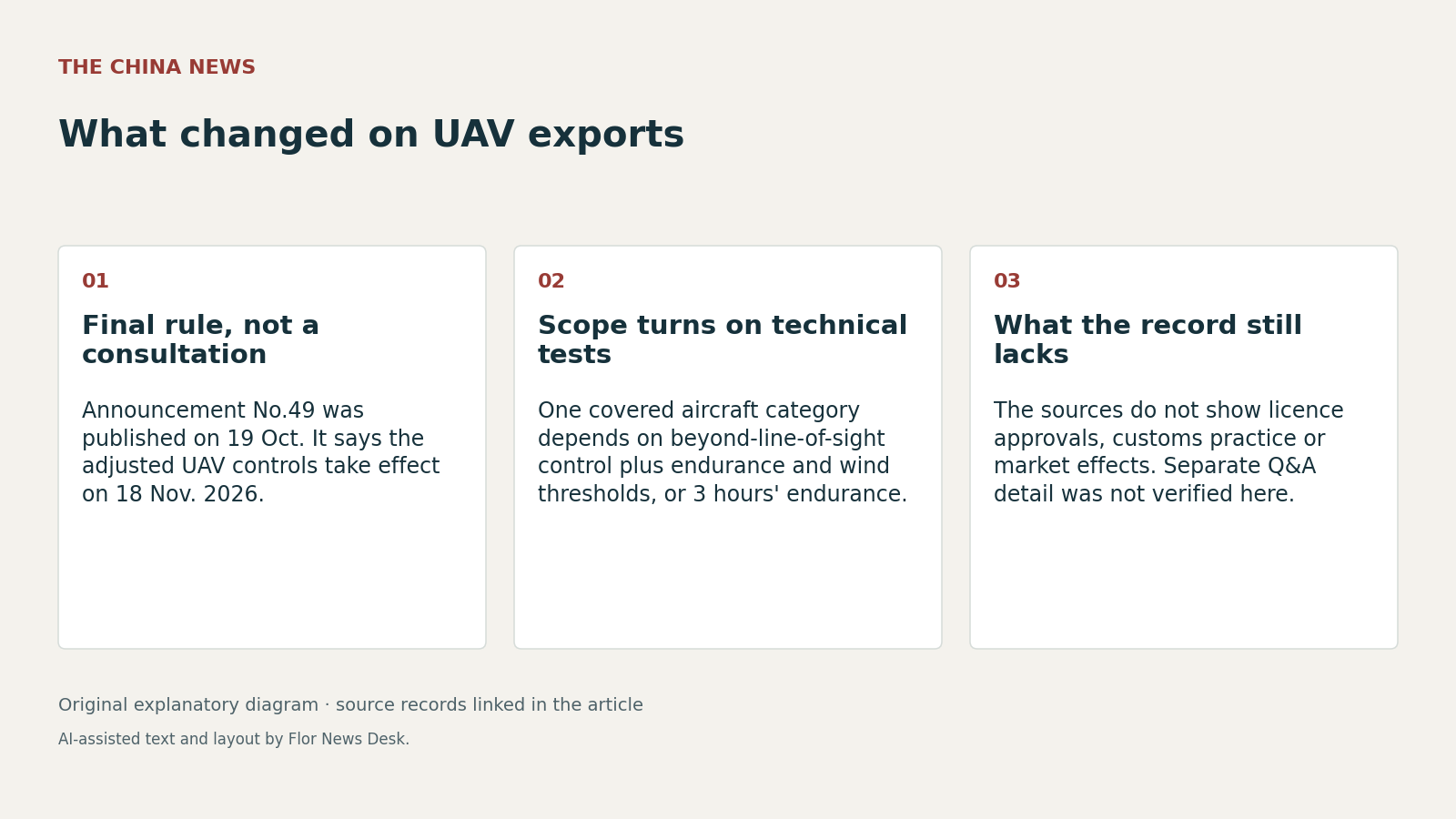
Beijing turned drone export control into a dated administrative change on 19 October, when the Ministry of Commerce, the General Administration of Customs and the Central Military Commission Equipment Development Department jointly published Announcement 2026 No.49 and said it would take effect on 18 November 2026. The notice says it was approved by the State Council and the Central Military Commission, which matters because it marks this as a formal control decision rather than a consultation paper or policy concept. Announcement 2026 No.49
What the notice does is narrower, and more technical, than a generic crackdown narrative suggests. According to the announcement, listed unmanned aerial vehicle-related items cannot be exported without a licence, including specified autopilots, software, technologies, engines, radio communication equipment and parts. For one controlled aircraft category, the test is not simply whether a product is a drone. The notice ties control to operation beyond the operator’s natural visual line of sight and then to endurance and wind-resistance thresholds, or to endurance of at least three hours. It also defines endurance by conversion to sea-level, zero-wind conditions under ISO2533:1975. That detail signals that classification disputes may turn on measurement methods, not only product marketing. Announcement 2026 No.49
The immediate compliance signal is twofold. First, exporters are told to apply to the State Council commerce authority for licences under the Export Control Law and the Regulations on Export Control of Dual-Use Items. Second, the same announcement says customs declarations must include a remark stating whether an item is controlled under this notice, and customs may question a filing and withhold release while that question is examined. On analysis, that means the 18 November change is not only about licence eligibility. It also creates a documentary classification step at the border, where disagreement over technical parameters could delay a shipment even before any broader enforcement trend is visible. Announcement 2026 No.49
A second Ministry of Commerce record from the same week helps clarify what kind of policy act this is, and what it is not. On 16 October, the Ministry of Commerce and the Ministry of Science and Technology opened public consultation on a proposed revision to the Catalogue of Technologies Prohibited or Restricted from Export from China and imposed temporary pre-export registration for listed technologies until any formal revision takes effect. That measure is explicitly a proposal plus interim management, with comments open through 15 November 2026. The UAV notice, by contrast, already has a fixed implementation date and licensing path. Treating both as identical “new controls” would blur the difference between proposal, temporary registration and binding implementation. Announcement 2026 No.48
The limits of the public record are just as important as the headline. The retrieved announcement does not show how many licence applications have been filed, approved or denied, how customs officers will test endurance or wind claims in practice, how long processing will take, or whether exporters and overseas buyers are already changing orders. The source set available for this draft also does not verify any separate technical Q&A beyond the text of the announcement itself, so broader claims about later guidance cannot be established here from the checked record. Announcement 2026 No.49
For readers tracking China’s trade controls, the useful conclusion is specific: from 18 November, UAV exporters will face a live licensing-and-customs classification regime whose scope depends on technical definitions, while the measured commercial and enforcement effects remain unknown. That is a stronger finding than saying China is merely considering tighter controls, but weaker than claiming any proved disruption to exports before implementation data exists. Announcement 2026 No.49 Announcement 2026 No.48