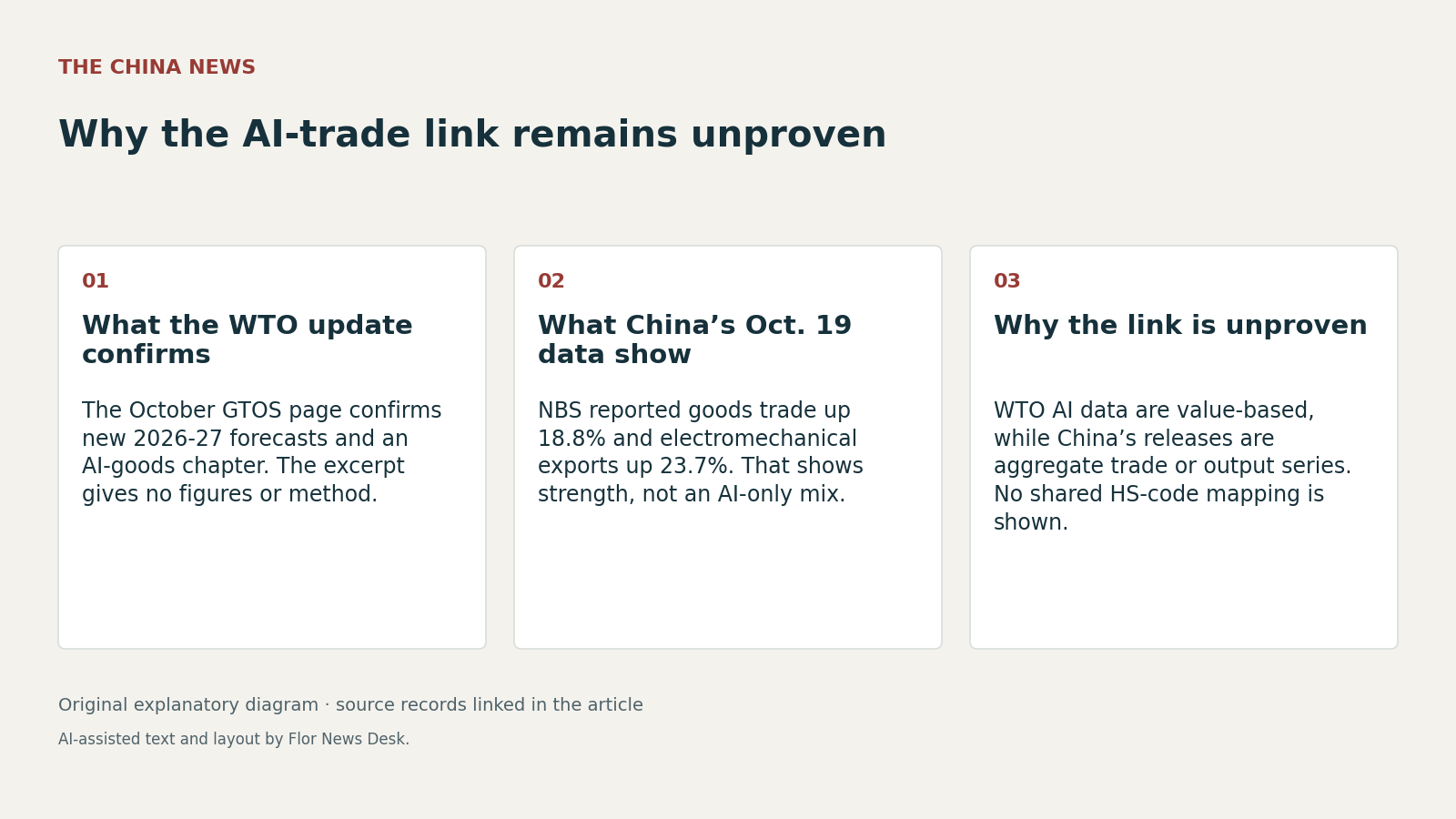
In an October 2026 update, the World Trade Organization signaled that AI-enabling goods have become important enough to warrant a dedicated analytical chapter in its *Global Trade Outlook and Statistics*. On October 19, 2026, China’s National Bureau of Statistics reported that goods trade in the first three quarters reached 39.9399 trillion yuan, up 18.8% year on year, with exports up 16.4% and imports up 22.3%. The same release said electromechanical exports rose 23.7% and accounted for 64.3% of total exports WTO GTOS page NBS main release. Read together, those records make an AI-related trade question plausible. They do not yet prove that China’s 2026 trade strength was driven by the WTO’s AI-enabling basket.
The first limit is on the WTO side. The October GTOS page says the update contains revised forecasts for world trade in 2026 and 2027, sectoral and regional breakdowns, and an analytical chapter on recent trends in AI-enabling goods trade WTO GTOS page. But the retrieved page excerpt does not provide the forecast numbers, the product list, or the methodology used to define AI-enabling goods. The most detailed WTO figures in this source set come instead from a July 2026 news item: world merchandise trade volume rose 3.2% year on year in the first quarter, the US-dollar value of AI-enabling goods trade rose by more than 40%, and Asia’s merchandise export and import volumes rose 12.9% and 14.6%, with much of the increase attributed by the WTO to intra-regional circulation of AI-enabling goods WTO July trade update. The same item says quantity figures are not available for those AI goods, which matters because value growth can reflect prices, product mix or volumes.
China’s October 19 releases do show an electronics-heavy trade and production upswing that fits that global backdrop. The statistics bureau said high-technology manufacturing value added rose 14.3% in January-September, computer, communication and other electronic equipment manufacturing rose 15.8%, integrated circuit output rose 23.3%, and industrial robot output rose 29.1% NBS industrial release. Those data sit alongside the rise in electromechanical exports NBS main release. As analysis, that combination is consistent with stronger demand for parts and equipment used in computing and automation supply chains. It is not a direct match to the WTO category, because no shared HS-code mapping appears in the retrieved records.
Some of China’s own sector figures also argue against reducing the story to a single AI boom. The same industrial release said output of microcomputer equipment fell 15.0% and smartphone output fell 9.0% in January-September NBS industrial release. Meanwhile, domestic retail sales of communications equipment rose 18.1% in January-September and 31.1% in September alone, but that series tracks domestic sales rather than exports NBS retail release. The mixed pattern suggests reallocation within electronics and equipment manufacturing, but the public data here cannot distinguish AI servers, networking gear, chips, consumer devices or ordinary cyclical restocking.
A second limit is that the Chinese series do not measure the same thing. The trade totals come from customs and are nominal values; the industrial release’s export delivery value is a production-linked indicator that rose 10.7% in January-September, not a merchandise export total NBS main release NBS industrial release. The main NBS release also says private firms accounted for 56.9% of trade and trade with Belt and Road partner countries rose 17.1% NBS main release. Those details matter for route and firm structure, but they still do not show whether WTO-defined AI-enabling goods were concentrated in any market or exporter group.
That leaves a narrower conclusion than the headline trade numbers suggest. The WTO has clearly elevated AI-enabling goods as a trade category in its October 2026 flagship update WTO GTOS page. China, on October 19, 2026, reported trade and industrial figures that are compatible with stronger electronics and equipment flows NBS main release NBS industrial release. What the present public record cannot establish is the connecting mechanism. To prove that link, later reporting would need the WTO chapter’s product definition or HS-code list, plus Chinese customs breakdowns by product and destination using comparable categories. Until then, the safest reading is that China is participating in a broader electronics and machinery upswing that may overlap with AI supply chains, but is not yet demonstrably identical to them.