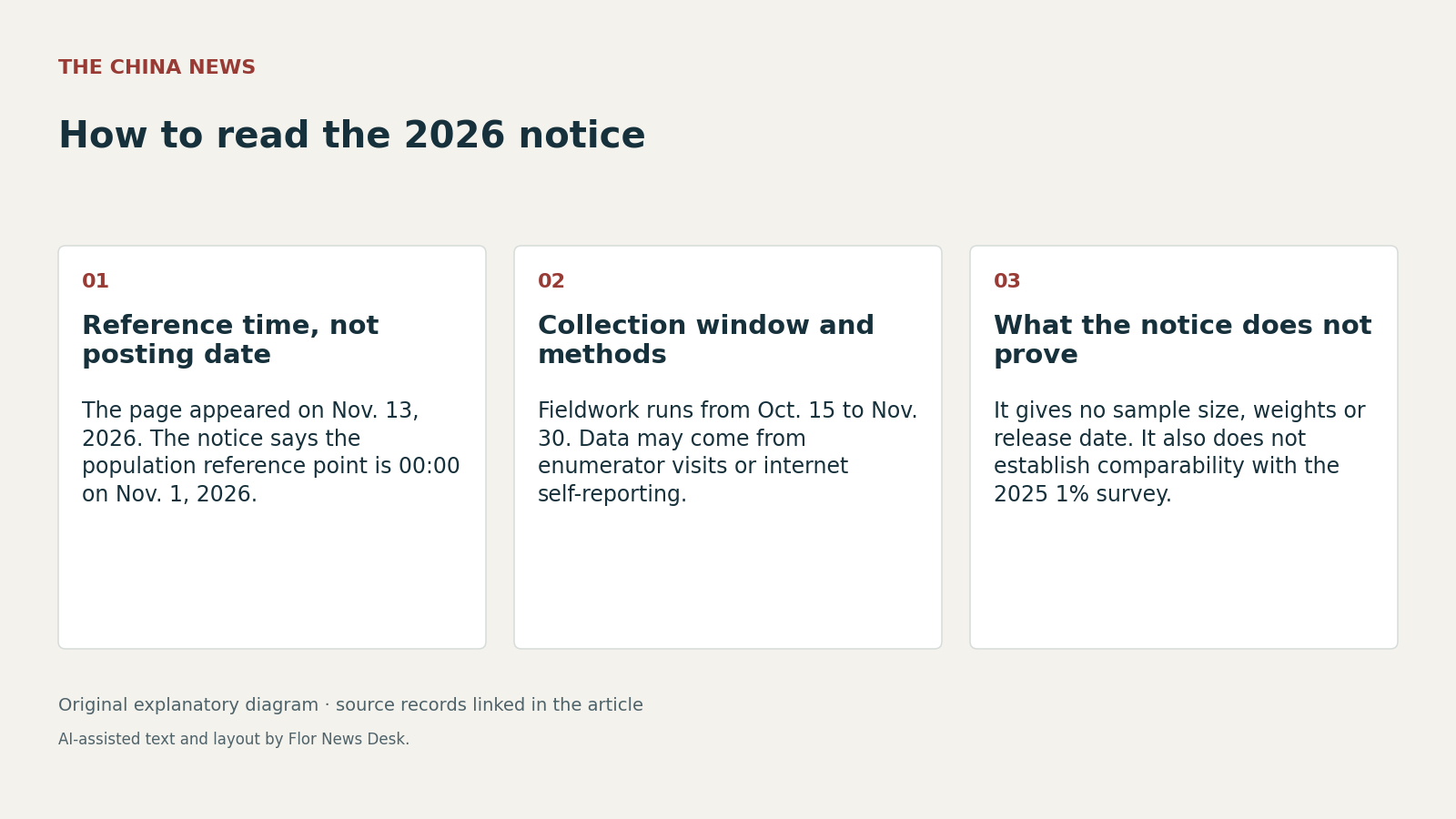

China’s National Bureau of Statistics posted a notice on 2026-11-13 saying it will organize a nationwide 2026 population-change sample survey in sampled urban and rural areas of mainland China, with a standard reference time of 00:00 on 2026-11-01 and fieldwork scheduled from 2026-10-15 to 2026-11-30 NBS notice. That is a procedural step, not a demographic finding. The source record shows an order to collect data, not a release of new population totals.
The notice is concrete about scope. It says registration is by household for people with People’s Republic of China nationality in sampled dwellings, including both family households and collective households, and it lists items such as name, citizen ID number, sex, age, ethnicity, education, migration and mobility, work, marriage and fertility, deaths, and housing conditions NBS notice. It also says information may be gathered either by in-person registration by government statistical investigators or by respondents’ internet self-reporting, while invoking confidentiality duties under the Statistics Law and possible public-security penalties for obstruction NBS notice.
For readers trying to interpret later releases, the most important distinction is between the page’s publication date and the survey’s measurement point. If the bureau later publishes estimates from this exercise, the notice says they are meant to describe the population as of 00:00 on 2026-11-01, even though collection spans from mid-October through the end of November NBS notice. That means the 2026-11-13 posting date does not itself mark when the counted population conditions occurred.
A second distinction is between this newly posted notice and an earlier 2026 household letter. On 2026-05-08, the bureau told households in a population fixed-sample follow-up survey that there would be two nationwide rounds in 2026, with reference times of 00:00 on 2026-06-01 and 00:00 on 2026-11-01; it said investigators would visit from 2026-06-01 to 2026-06-25 and from 2026-11-16 to 2026-12-05 household letter. The shared 2026-11-01 reference time suggests coordination across population-statistics work, but the source record does not prove that the fixed-sample follow-up and the 2026 population-change sample survey are the same operation, linked samples, or separate programs. Their published fieldwork windows also differ.
The latest directly evidenced benchmark for how the bureau has published large population samples is the 2025 1% National Population Sample Survey. In an English-language communiqué issued on 2026-05-22, the bureau said that survey used 00:00 on 2025-11-01 as its reference time and reported a national sample of 20.52 million persons, or 1.46% of the population, with a post-enumeration net undercount rate of 0.72% 2025 1% survey communiqué. That record shows one documented gap of more than six months between a November reference point and publication of headline estimates. It does not show that the 2026 survey will use the same questionnaire, definitions, sample design or release calendar.
What remains unknown is as important as what has been announced. The 2026 notice gives no sample size, weighting method, estimation procedure, publication timetable or microdata plan, and the page was published on 2026-11-13 even though the notice is signed 2026-09-15, without explaining what work happened in between NBS notice. On the present record, the prudent reading is narrow: the bureau has defined who may be counted, what may be asked and when the survey is supposed to measure the population. It has not yet shown what the survey found, or whether its eventual estimates will be directly comparable with the 2025 1% survey.