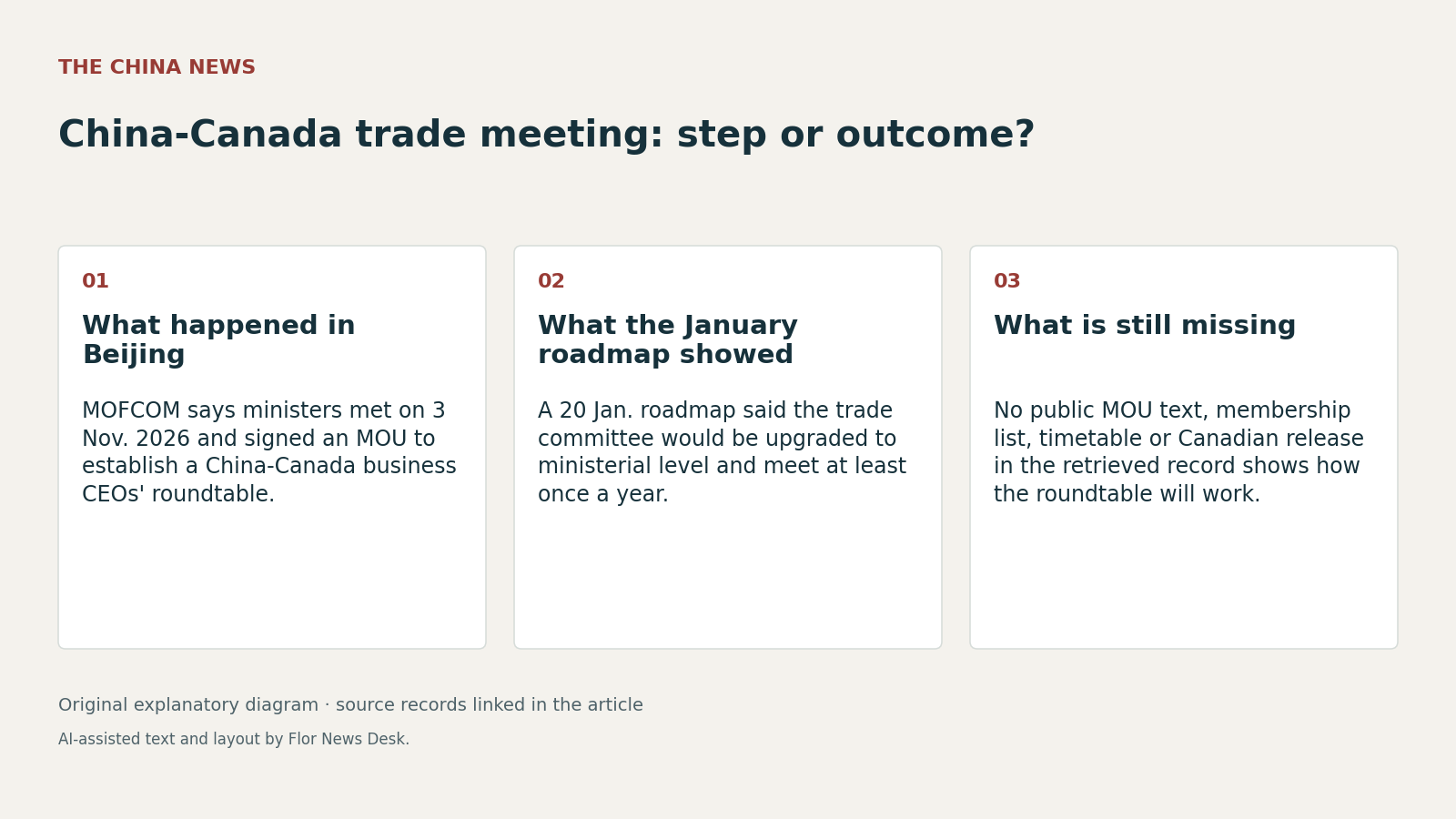
Beijing’s concrete new China-Canada trade development on 3 November was institutional, not commercial. China’s Ministry of Commerce said Commerce Minister Wang Wentao and Canada’s Minister of International Trade Sidhu co-chaired the 29th China-Canada Economic and Trade Joint Committee in Beijing, and that the two sides then signed a Memorandum of Understanding to establish a China-Canada Business CEOs’ Roundtable. MOFCOM published that account on 4 November. MOFCOM account
The strongest evidence of substantive movement is not the MOU alone, but the meeting’s rank. MOFCOM described the 29th session as the mechanism’s first ministerial-level meeting. That matters because a MOFCOM roadmap published on 20 January said China and Canada would strengthen the China-Canada Economic and Trade Joint Committee and upgrade it to a trade-minister-led mechanism meeting at least once a year. On the Chinese record, the 3 November session therefore looks like follow-through on one specific January institutional commitment. MOFCOM account China-Canada Economic and Trade Cooperation Roadmap
That does not mean the public record shows new market access, tariff relief or investable sector openings. MOFCOM said the ministers discussed bilateral economic and trade relations, cooperation in traditional and emerging sectors, and each side’s trade concerns. It also said Li Chenggang, China’s international trade representative at ministerial rank and vice minister of commerce, attended, and that Wang and Sidhu joined a China-Canada investment and trade roundtable before the committee meeting. Those are signs of resumed official contact, but they are still broad process descriptions rather than documented policy outcomes. MOFCOM account
The new CEOs’ roundtable MOU should be read in the same narrow way. An MOU to establish a business roundtable can create a channel for companies to surface problems or lobby for cooperation. But this record does not publish the MOU text, a charter, a membership list, a meeting calendar, sector working groups or any agreed deliverables. Without those elements, readers cannot tell whether the body will be consultative, ceremonial or tied to specific negotiations. The retrieved record also contains no Canadian government release that confirms the same framing or sets out Canada-side next steps. MOFCOM account
The January roadmap is useful mainly as context, and it has time limits. MOFCOM said that document followed consensus reached during Prime Minister Carney’s January 2026 visit to China, and it listed plans including an Economic Partnership Working Group meeting in Canada in summer or autumn 2026, a restart of the intellectual property working group and possible progress on trade-remedies talks. Because those milestones were written as future expectations in January, they cannot be treated on 4 November as proof of completion or delay. The roadmap shows ambition; it does not establish which items were implemented. China-Canada Economic and Trade Cooperation Roadmap
For readers trying to judge whether this meeting changes the commercial picture, the next evidence to watch is straightforward: publication of the roundtable’s terms of reference, a named roster of participating companies, a scheduled first session, a communiqué carried by both governments, or sector-specific agreements that alter customs, investment or market-entry conditions. Until documents like that appear, the safest conclusion is limited but still important: China and Canada have publicly revived ministerial trade machinery, while the business mechanism announced in Beijing remains a procedural framework rather than a proven economic result. MOFCOM account China-Canada Economic and Trade Cooperation Roadmap