Beijing’s official purchasing managers’ survey turned weaker on 1 November 2026, but it did not overturn the earlier output data that still showed growth. The National Bureau of Statistics and the China Federation of Logistics & Purchasing put October’s manufacturing PMI at 49.3 and the composite PMI output index at 49.7, both below the 50 line that the release uses to signal month-on-month contraction. The same release says the indexes are seasonally adjusted diffusion measures, not direct tallies of production or payrolls. October PMI, 1 November 2026
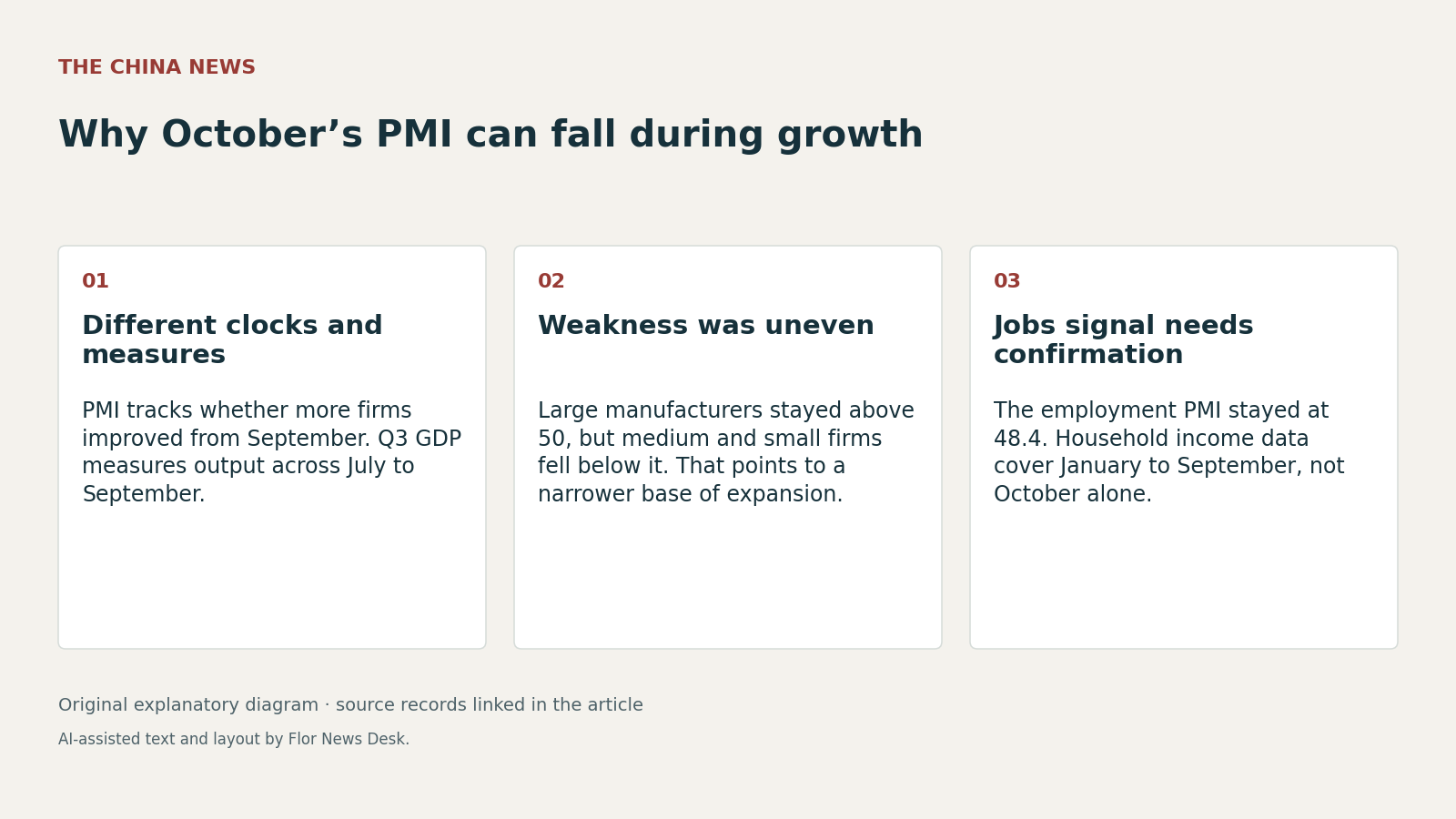
That difference in method matters more than the apparent contradiction. The GDP release published on 21 October 2026 covers the whole third quarter, not October alone, and NBS described it as preliminary accounting. It reported Q3 GDP up 4.5% year on year at constant prices and 1.2% quarter on quarter after seasonal adjustment. In other words, GDP says output in July to September was still larger than a year earlier and higher than in the previous quarter; the PMI asks whether more firms improved from September to October. Those are different clocks and different questions. Q3 GDP, 21 October 2026
The October PMI also points to unevenness, not a single nationwide factory story. Large manufacturers remained above 50 at 50.2, while medium-sized firms fell to 48.4 and small firms to 47.5. Within manufacturing, both production and new orders slipped below 50, at 49.8 and 49.4, while the employment index stayed at 48.4. The strongest sourced inference is that October’s cooling was broad enough to pull the headline below 50, but not broad enough to include every firm category. The record does not show which provinces drove that gap. October PMI, 1 November 2026
September’s industrial data help explain how positive output and a weaker PMI can coexist. On 20 October 2026, NBS said value added for industrial enterprises above the designated size rose 5.5% year on year in September, with manufacturing up 6.0% and high-technology manufacturing up 15.3%. It also reported strong gains in electronics equipment, special-purpose machinery, transport equipment, industrial robots, integrated circuits and new energy vehicles. Those figures show that sizeable producers in selected industries were still lifting measured output before October began. But the same release covers only enterprises above the designated size, defined there as firms with annual main business revenue of 20 million yuan or more, so it cannot stand in for conditions at smaller manufacturers that the PMI shows weakening. Industrial production, 20 October 2026
The non-manufacturing side suggests the slowdown signal was not confined to export lines or factory floors. October’s non-manufacturing business activity index was 49.7, with construction at 48.0 and services at 50.0. That aligns, at least directionally, with the Q3 GDP release, which showed tertiary industry growing 5.2% year on year while construction contracted 4.4% and real estate edged down 0.4%. The records do not prove that October construction sentiment caused the earlier quarterly weakness, but together they point to a persistent drag outside the strongest manufacturing niches. October PMI, 1 November 2026 Q3 GDP, 21 October 2026
Jobs are the part to watch most carefully, and the current record is limited. A PMI employment reading below 50 means fewer surveyed firms reported staffing increases than decreases from the previous month; it does not measure total employment. Separately, NBS said first-three-quarter per capita wage and salary income was 19,653 yuan, or 57.4% of disposable income, while real consumption expenditure rose 2.7%. If sub-50 employment readings were to persist, that could matter for household demand. What the available documents cannot establish is whether October alone changed national income or spending. For now, the most defensible reading is narrower: China still had positive Q3 growth and strong September output in some advanced industries, but by October a smaller share of firms, especially outside the largest manufacturers, were reporting improvement. Household income and consumption, 20 October 2026 October PMI, 1 November 2026