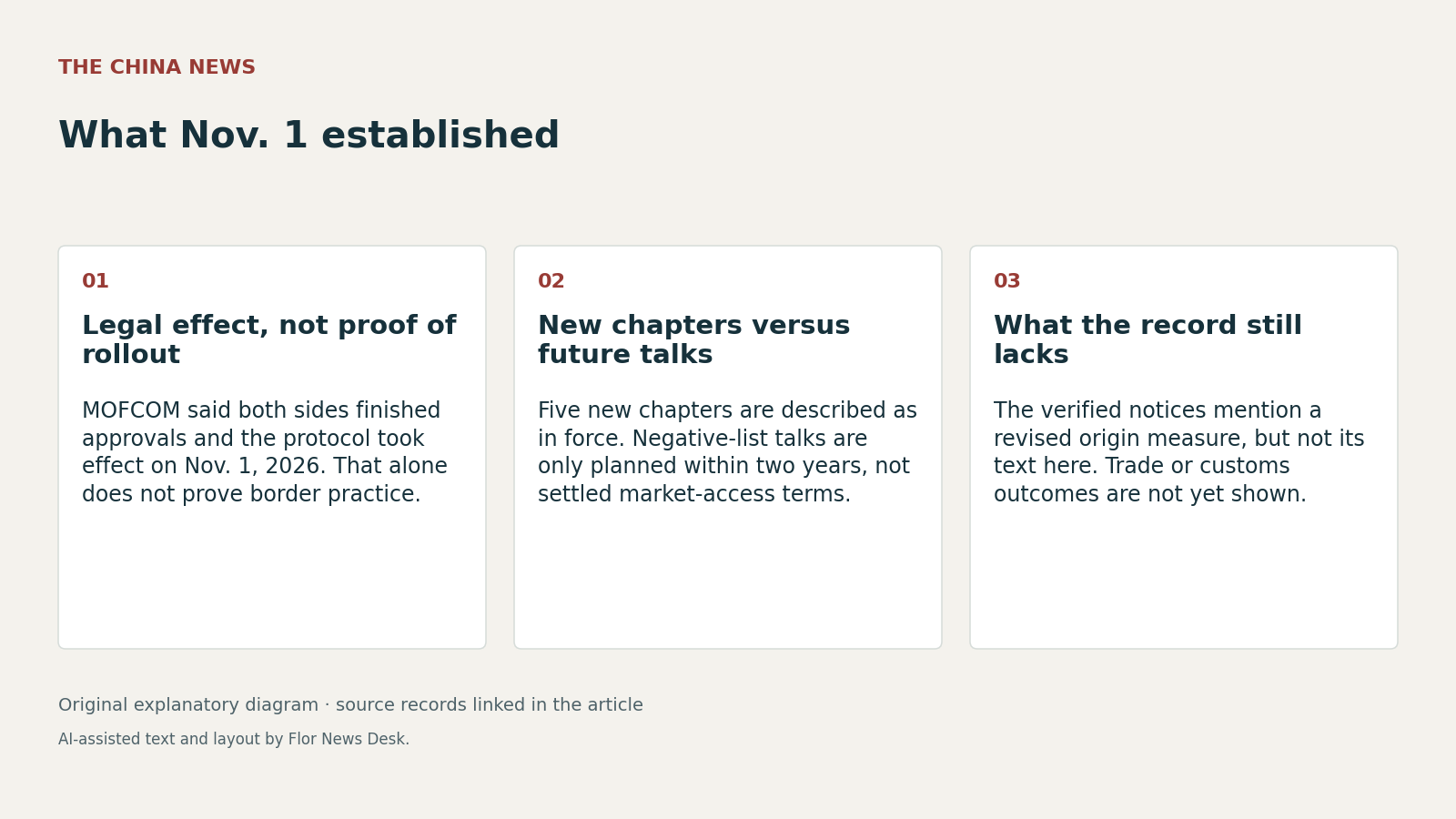

On Nov. 1, 2026, the immediate change in the China–Peru trade relationship was legal, not yet evidentiary. China’s Ministry of Commerce, or MOFCOM, said the protocol upgrading the China–Peru Free Trade Agreement entered into force that day, and a separate MOFCOM official account said this followed completion of domestic approval procedures in both countries. Those two points establish that the upgrade is in effect as a matter of treaty status; they do not by themselves prove how quickly customs offices, certification systems or firms are applying every provision in day-to-day trade [MOFCOM announcement] [MOFCOM official briefing].
The record also lets readers separate an upgrade from a brand-new agreement. MOFCOM said the original China–Peru FTA was signed in April 2009 and entered into force in March 2010, while upgrade negotiations began in November 2018 and the protocol was signed on Nov. 14, 2024 [MOFCOM official briefing] [MOFCOM announcement]. That chronology matters because Nov. 1, 2026 is not the start of China–Peru free trade. It is the date on which a negotiated update to an existing framework became operative.
According to MOFCOM’s Nov. 1 announcement, the protocol revises seven existing areas, including rules of origin, customs procedures and trade facilitation, sanitary and phytosanitary measures, intellectual property, services, temporary entry for business persons and investment. MOFCOM also said five new chapters are added: standards and conformity assessment cooperation, competition policy, e-commerce, global supply chains, and environment and trade [MOFCOM announcement]. The narrow conclusion supported by that record is that these subjects now sit inside the upgraded legal text. The record does not, by itself, show which operational changes traders will notice first.
That gap is most visible on origin administration. MOFCOM’s official briefing said the protocol text had been posted on the China FTA service website and that the General Administration of Customs had issued a revised origin-management measure for imports and exports under the China–Peru FTA [MOFCOM official briefing]. But in the verified records supplied here, neither the protocol text nor the customs measure itself is available for inspection. As of the Nov. 3, 2026 retrieval date, that means this draft can state that implementation materials were referenced, but cannot responsibly specify certificate formats, documentary thresholds, verification procedures or local rollout timetables from those unseen texts.
The same caution applies to what MOFCOM described as future work. The official briefing said the two sides plan to start negotiations on negative lists for services trade and investment within two years after the protocol takes effect, and to review the competition chapter every two years for possible higher commitments [MOFCOM official briefing]. In analysis terms, those are built-in next steps, not evidence that market-access schedules on a negative-list basis already exist or that tougher competition obligations have been agreed.
MOFCOM’s announcement also said bilateral trade rose from US$6.4 billion in 2009 to US$50.4 billion in 2025 and credited the existing FTA with helping economic and trade cooperation [MOFCOM announcement]. That is an institutional claim about the earlier agreement’s role, not proof of what the 2026 upgrade has achieved. So the clearest reading after Nov. 1 is limited but useful: China and Peru have moved the upgraded pact from signature to force, added new issue areas to the legal framework, and opened a new implementation phase whose concrete customs and commercial effects are not yet demonstrated in the verified public record used here.