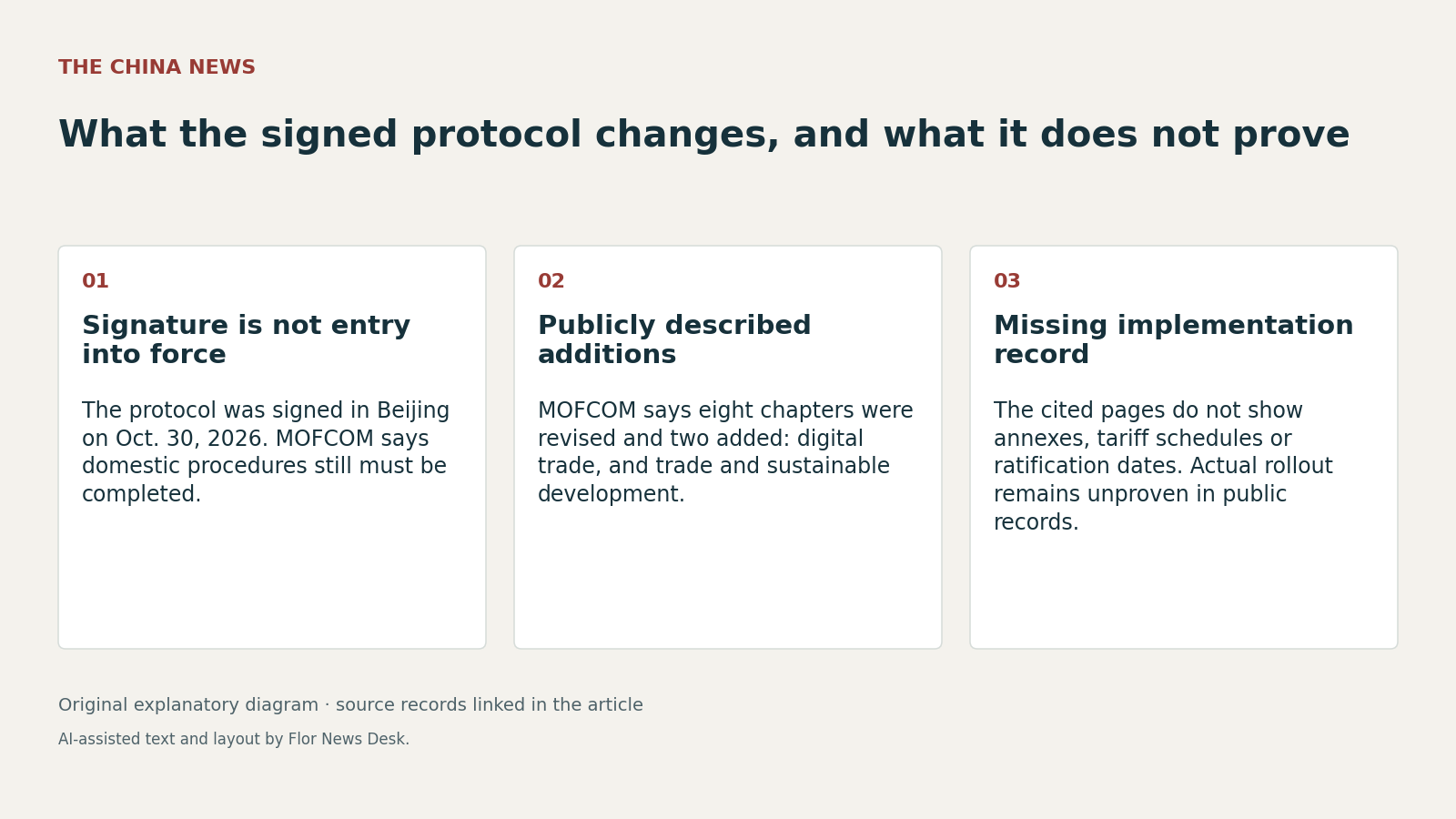
China and Switzerland signed an upgraded protocol to their free trade agreement in Beijing on Oct. 30, 2026, under the witness of the two heads of state, according to a Ministry of Commerce interpretation published that night and repeated at a Nov. 5 regular briefing (MOFCOM interpretation, Oct. 30, 2026; MOFCOM briefing, Nov. 5, 2026). The immediate point for readers is narrower than the ceremony: MOFCOM also says each side still must complete its own domestic procedures before the protocol can take effect, so the signing is a legal and diplomatic milestone, not proof that new tariff or services access is already operating.
What the public record does establish is that the upgrade goes beyond a small tariff clean-up. MOFCOM says the protocol revises eight chapters of the original agreement and adds two new ones, on digital trade and on trade and sustainable development. It also says both sides agreed further tariff cuts on close to 300 tariff items, and that goods eventually reaching zero tariffs would account for more than 99% of bilateral trade value (MOFCOM interpretation, Oct. 30, 2026). The wording matters. “Eventually” and “once effective” describe a future result, not a measured outcome as of Nov. 14, 2026.
The examples MOFCOM chose show how Beijing wants the deal read. On the Swiss side, official summaries highlight coffee, machine tools, watches and medical products. On the Chinese side, they point to oil seeds, vegetable oils and pet food (MOFCOM briefing, Nov. 5, 2026; MOFCOM interpretation, Oct. 30, 2026). That spread across agriculture, consumer goods and industrial products suggests the upgrade is being presented as balanced across both economies, even though the public materials still do not disclose the tariff-line annexes that would show the commercial weight of each concession.
The services story is potentially as important as the goods story, but it is even less documented in the public summary. MOFCOM says Switzerland made new commitments in movement of natural persons, traditional Chinese medicine, and equipment repair and maintenance. China, according to the same records, opened manufacturing-related services and professional design and made commitments in finance, maritime transport and air transport (MOFCOM briefing, Nov. 5, 2026; MOFCOM interpretation, Oct. 30, 2026). Without schedules, reservations or implementation notes, however, the record does not yet show how wide those openings are or which firms could actually use them.
The most novel rule-making claim concerns digital trade. MOFCOM says the new chapter covers no customs duties on electronic transmissions, personal-information protection and fully digital customs clearance, and it adds that source-code protection appears here for the first time in one of China’s bilateral free trade agreements (MOFCOM interpretation, Oct. 30, 2026). That does not by itself prove how broad the protection is, because the public summary does not include the operative legal text or any exceptions. Still, as analysis, the claim matters because it signals the kind of digital-trade language Beijing now wants attached to at least some bilateral deals.
The timeline also helps explain the political message. MOFCOM said on Aug. 21 that the two sides had completed upgrade negotiations in Bern on Aug. 20 after five rounds that began in September 2024, and it described the 2013 agreement as China’s first FTA with a continental European country (MOFCOM release, Aug. 21, 2026). Moving from completion in August to signature in October suggests official urgency, but not implementation speed. The next records that would materially change the story are domestic approval notices, an entry-into-force date, and publication of the annexes and customs guidance that the current public record does not provide.