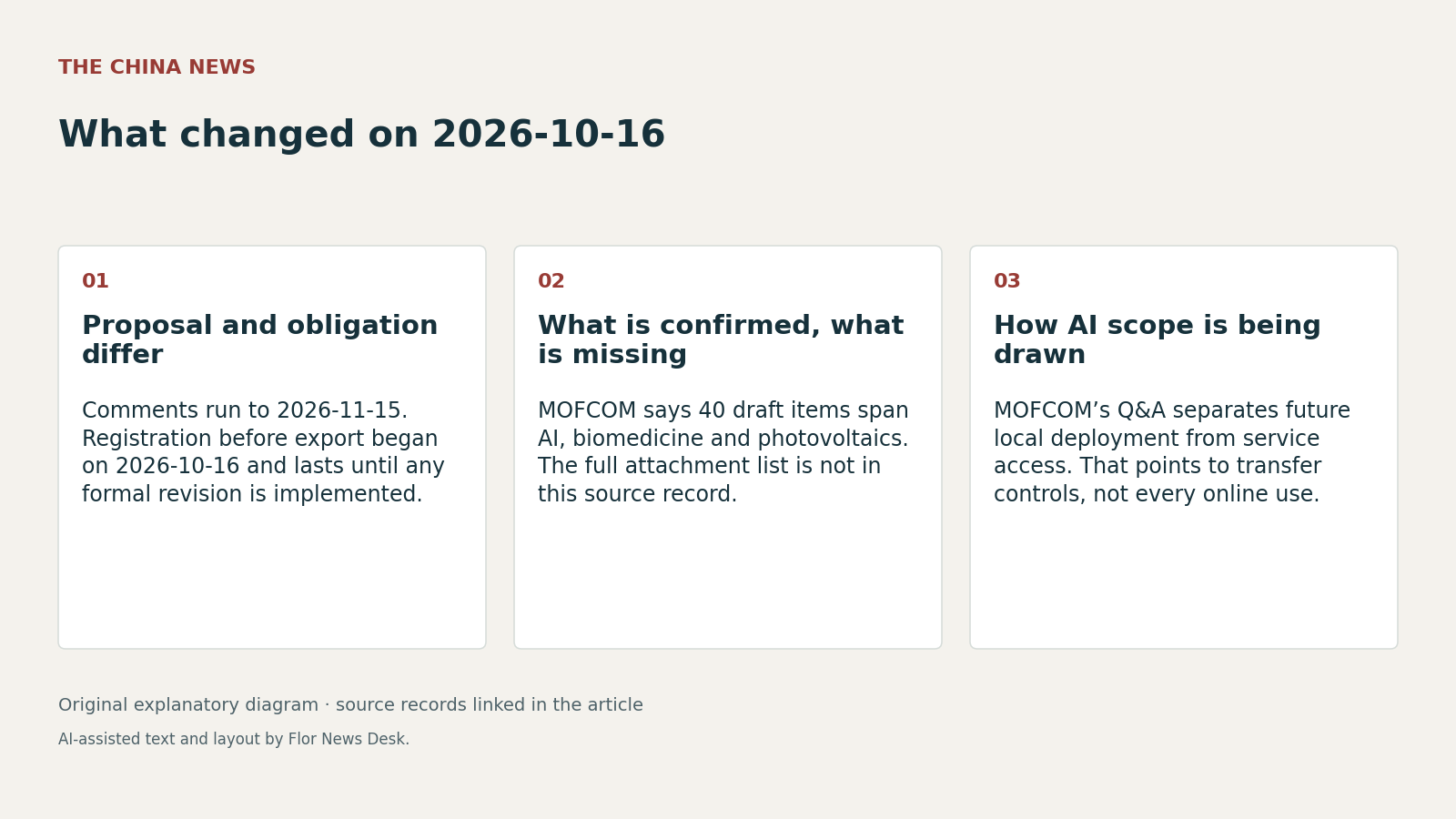
Beijing moved from consultation to immediate administration on 2026-10-16. The Ministry of Commerce and the Ministry of Science and Technology opened public comment on a revision to the China Prohibited and Restricted Export Technology Catalogue covering 40 draft items in artificial intelligence, biomedicine and photovoltaics. On the same date, the notice also started temporary pre-export registration for exports involving the listed technologies, with comments open until 2026-11-15. MOFCOM announcement MOFCOM Q&A
The practical distinction matters more than the headline number. A catalogue revision is still a proposal, but the registration step is already in force under the ministry notice and runs until a formal revision is later issued and implemented. According to the announcement, exporters must register through MOFCOM’s technical-trade system before exporting a covered technology, and the requirement also reaches transactions already under way but not finished, overseas-use authorizations, and changes in ownership or actual control to a foreign entity. MOFCOM announcement
What the public record currently proves is narrower than the policy debate it will invite. MOFCOM says the draft spans 23 AI items, 5 biomedicine items and 12 photovoltaic items. Its Q&A adds that 14 would be proposed for prohibition and 26 for restriction, and gives examples drawn from malicious-code generation, cell and gene therapy platforms and high-capacity polysilicon engineering. But the source record available here does not include the attachments with the full 40-item list or technical thresholds, so the exact boundaries of coverage cannot yet be established from these pages alone. MOFCOM announcement MOFCOM Q&A
The AI discussion is the clearest sign of what regulators appear to be trying to separate. The announcement says technologies already in the public domain through open-source release or academic publication are outside management. The Q&A further says that, once a formal revision takes effect, overseas localized deployment of restricted AI technology would fall within technology-export management, while API access, app or web interaction, SaaS use and lightweight local end-device deployment would not. That does not settle the final legal text, but it indicates an official attempt to distinguish transfer of a technology capability from remote access to a service. MOFCOM announcement MOFCOM Q&A
The biomedicine and photovoltaic sections show that the exercise is not only about software. The announcement places cell and gene therapy, small nucleic acid drugs, pathogen-related technologies, polysilicon manufacturing, wafer manufacturing and battery manufacturing into the same consultation, and says key equipment carrying relevant photovoltaic know-how is also within the management range. MOFCOM’s spokesperson said the revision is part of routine catalogue maintenance since 2001 and is not aimed at a specific country, region or entity. Even with that caveat, the cross-sector mix suggests Beijing is treating industrial process know-how and advanced research platforms as export-control subjects alongside frontier AI. MOFCOM announcement MOFCOM Q&A
For readers tracking China’s technology links with the world, the immediate issue is therefore administrative rather than interpretive. Until the attachments are checked and any final revision is published, the records do not show the definitive 40-item wording, any completed implementation, or any enforcement outcome. What they do show is a live consultation in Beijing and a present-tense obligation for affected exporters to decide whether their planned transfers fall inside the temporary registration net before any formal catalogue amendment arrives. MOFCOM announcement MOFCOM Q&A