In New York and Washington, Chinese and U.S. trade teams met from Sept. 20 to 23, and China’s Ministry of Commerce said on Sept. 28 that the talks produced four notable outcomes: a China-U.S. Trade Council, a reciprocal tariff-cut framework covering about US$30 billion of imports on each side, an agricultural working group, and an AI dialogue plus an incident channel. The public record so far shows intended architecture. Whether it changes trade flows or crisis management depends on later texts and domestic procedures that were not included in the retrieved pages. (MOFCOM explainer)
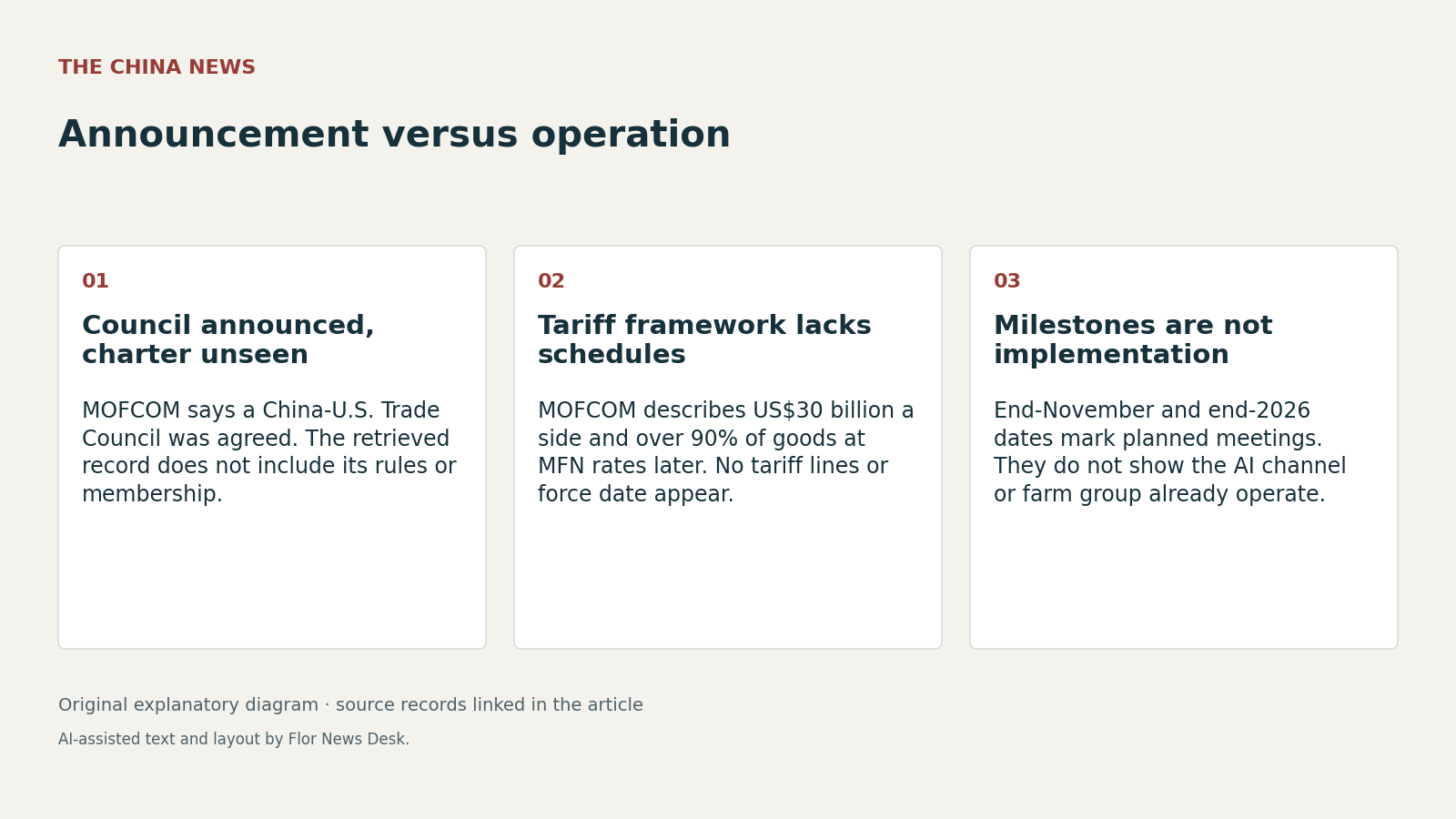
The clearest gap is between creating a body and publishing the rules that make it usable. MOFCOM said the Trade Council would sit under the bilateral economic and trade consultation mechanism, and a second Sept. 28 page said the Sept. 20 to 23 consultations reached consensus on the council’s rules, a responsibilities document for the tariff framework, and product lists. Yet the same record says details on the council’s tasks, structure, responsibilities and consultation arrangements would be released later, and the cited attachments were not part of the retrieved page. Until those documents appear, readers cannot tell who participates, what disputes it can handle, or whether it can do more than convene more talks. (MOFCOM explainer; MOFCOM framework note)
The tariff announcement is similarly precise on headline size but incomplete on execution. MOFCOM said the framework uses 2024 bilateral trade as its reference, covers roughly US$30 billion of imports on each side, and would return more than 90 percent of covered products to most-favored-nation tariff treatment after each side completes its own legal procedures. The ministry also listed sample categories, including toys and household appliances on the U.S. side’s covered imports from China, and agricultural products and medical devices on China’s covered imports from the United States. That still leaves the operative questions unanswered: the retrieved record does not provide tariff lines, exact rate changes, effective dates, or proof that domestic approvals are finished. (MOFCOM framework note; MOFCOM explainer)
For exporters, farmers and trade-finance providers, that distinction matters more than the US$30 billion headline. A nominal trade value does not show which firms benefit first, because the commercial effect turns on the missing product lists and the goods left outside the framework. An importer deciding whether to ship in October 2026 needs the legal notice that changes the rate, not only the statement that a framework exists in principle. The same logic applies to lenders assessing which shipments may qualify for revised customs treatment. (MOFCOM framework note)
The agricultural working group is the most concrete near-term milestone, but not yet the most defined institution. MOFCOM said it would sit under the Trade Council, be jointly led by China’s Ministry of Commerce and the Office of the United States Trade Representative, discuss regulatory and market-access issues, and hold a first meeting before the end of 2026. That is enough to identify the intended channel, but not enough to know whether it will produce specific inspection, licensing or access changes. Because the tariff framework’s China-side examples include agricultural products, readers should watch whether future records treat tariff cuts and agricultural regulatory issues as linked or as separate negotiations. (MOFCOM explainer; MOFCOM framework note)
MOFCOM also said the two sides established an AI dialogue, already held a first exchange, aimed to meet again before the end of November 2026, and agreed to create a communication channel for AI incidents. Here again, the difference between dialogue and operation is crucial. The retrieved record does not include a protocol naming participants, triggers, response expectations, or reporting rules for that incident channel. As of Sept. 29, 2026, the public evidence used here shows announced intent and planned milestones, not completed implementation. The practical next records to watch are the missing attachments, domestic tariff notices, and the agendas or readouts of the promised meetings. (MOFCOM explainer)