Beijing’s second regular meeting of the China-EU Trade and Investment Consultation Mechanism, held on 8-9 October 2026, appears from the available record less like a breakthrough than a decision to keep several hard disputes inside one managed channel. China’s Ministry of Commerce said Commerce Minister Wang Wentao and European Commission Commissioner for Trade and Economic Security Maroš Šefčovič co-chaired the talks, and that the review covered trade and investment balance, export controls, intellectual property and WTO reform. That matters because it shows the mechanism being used as a container for both immediate frictions and longer-running rule disputes, not a single-issue negotiation. MOFCOM readout
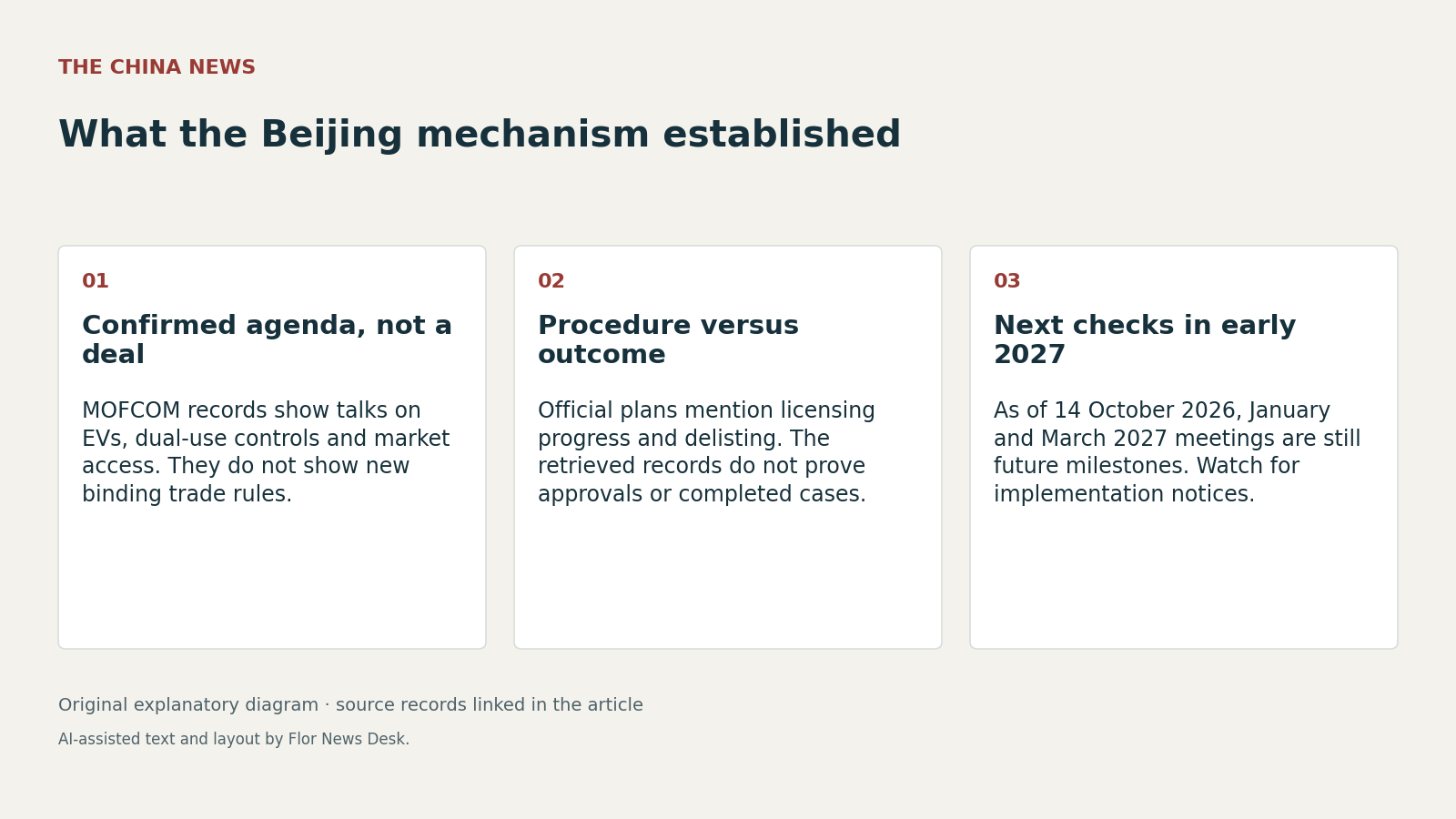
The most useful distinction for readers is between agenda breadth and policy change. MOFCOM’s 10 October explanation linked the meeting to specific sector complaints, including medical devices, cosmetics, pharmaceuticals, inverters and agri-food products, while the 9 October readout said the two sides agreed to keep communicating on market-access concerns and to hold technical dialogue on the EU Foreign Subsidies Regulation. Those are concrete topics, but the retrieved records do not show any published market-opening measure, tariff change or resolved complaint in those sectors. MOFCOM explanation MOFCOM readout
The electric-vehicle file shows the same pattern. According to MOFCOM’s explanation, the two sides discussed electric vehicle and hybrid vehicle trade, reviewed an earlier general guidance document on price undertakings in the EU anti-subsidy case on electric vehicles, and the EU would actively advance company price-undertaking and review procedures. That is procedurally meaningful because it suggests the mechanism is being used to move case handling forward. But it is not the same as a published settlement: the source record here does not include the earlier guidance document, any company list, or evidence that a price undertaking was accepted. MOFCOM explanation
Export controls are the area where the official texts come closest to operational follow-up, and even there the limits are clear. MOFCOM said the two sides agreed to strengthen the China-EU export control dialogue mechanism, continue policy communication, address case-specific concerns and study possible facilitation measures. Its Europe Department explanation went further, saying the EU would keep pushing progress on key dual-use licensing cases involving China, and that both sides supported reciprocal delisting procedures within their legal frameworks. As analysis, that combination suggests officials wanted the meeting to show movement on compliance-heavy trade rather than only on rhetoric. Still, the records do not establish that any licence was granted, any entity was delisted or any facilitation measure had taken effect by 14 October 2026. MOFCOM readout MOFCOM explanation
The clearest new outcome is scheduling. MOFCOM’s explanation said the sides planned a ministerial video meeting in January 2027 and a third regular meeting of the mechanism in March 2027. That gives businesses and diplomats a near-term watch list: whether those meetings occur, whether either side publishes fuller implementation notes, and whether any company-specific EV or dual-use procedures actually move. As of 14 October 2026, however, those dates remain announced next steps rather than completed follow-through. MOFCOM explanation
One more limit matters. In the source record used here, no EU-side document is retrieved, and the MOFCOM readout says a joint statement was issued without providing that text in the material summarized above. That does not negate the meeting. It does mean the safest reading is a narrow one: Beijing produced a denser calendar and a wider official inventory of disputes, but not yet a documented settlement of the China-EU trade frictions it named. MOFCOM readout