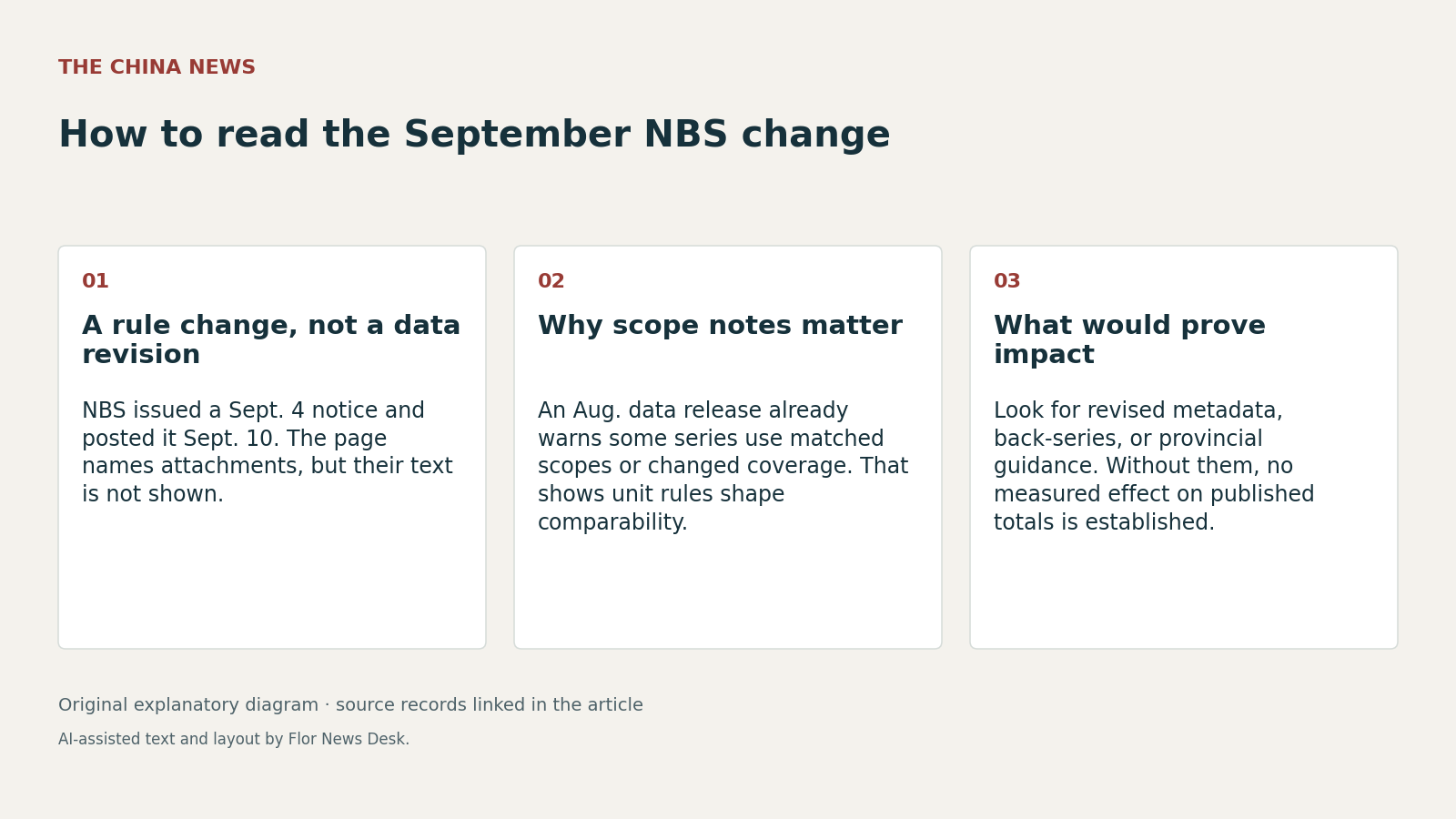

China’s National Bureau of Statistics issued a 4 September notice revising 《统计单位划分及具体处理办法》, and published that notice on its website on 10 September. The bureau said the revision was intended to standardize statistical units, improve data quality and promote 经营主体活动发生地统计, meaning statistics based on where a business entity’s activity occurs. That is a concrete administrative change. But the public page shows only the notice and the names of three attachments, not the attachment text itself, so the exact clause-by-clause changes are not visible in this record. NBS notice, 10 Sept. 2026
Why should readers of China’s monthly indicators care about a technical rule for statistical units? Because the way the bureau defines and tracks reporting units affects what can be compared across time and across places. In its release on August 2026 economic performance, published on 15 September, the bureau said industrial and above-threshold wholesale, retail, accommodation and catering comparisons are calculated on matched scopes because reporting coverage changes as firms enter, exit, open, close or fall below thresholds. The same notes said the newer indicator for online sales of goods and services is not comparable with the older online retail series because the statistical scope was expanded. Those warnings show that coverage rules already shape headline readings. August economy release, 15 Sept. 2026
A second document, the bureau’s statistical reform and development plan published on 16 September, places the September notice inside a broader reform agenda. In the section on statistics for a unified national market, the plan says the bureau will revise 《统计单位划分及具体处理办法》, clarify counting by the place where business activity occurs, strengthen the management and statistical inclusion of 视同法人单位, optimize statistics for headquarters and branch institutions, and improve the enterprise organizational structure survey and its implementation. Read together, the notice and the plan support an analytical inference: the bureau is trying to tighten the link between statistical reporting and where economic activity actually happens, especially where corporate structures span more than one location. NBS planning document, published 16 Sept. 2026 NBS notice, 10 Sept. 2026
That still does not establish a current data revision. The notice page does not provide the attachment contents, so this source set does not show which provisions were amended, whether a transition period was set, or how local statistical offices were instructed to apply the new rules. The August macro release does not say its published figures were altered by the 4 September notice, and the 16 September plan is a reform programme, not proof of completed implementation by 7 October 2026. NBS notice, 10 Sept. 2026 August economy release, 15 Sept. 2026 NBS planning document, published 16 Sept. 2026
The most plausible area of future impact is regional attribution. If implementation later pushes more reporting toward the place where production, sales or services occur, some activity now associated in practice with headquarters cities or branch-heavy corporate structures could be reallocated, or at minimum re-described, in metadata. That is analysis from the bureau’s stated reform direction, not a reported result. The current record does not show revised GDP, employment, industrial output, retail sales or firm-count series, and it does not show back-series tables reconciling old and new treatment. NBS notice, 10 Sept. 2026 NBS planning document, published 16 Sept. 2026
The practical test now is straightforward. Evidence of substantive implementation would have to appear in later records such as revised indicator notes, published historical back-series, provincial explanations of how branches or other units are counted, or survey documentation linked to the organizational-structure work named in the reform plan. Until such records appear, the September notice should be read as a meaningful rules change with possible consequences for interpretation, not as proof that China’s published economic statistics have already been restated. August economy release, 15 Sept. 2026 NBS planning document, published 16 Sept. 2026 NBS notice, 10 Sept. 2026