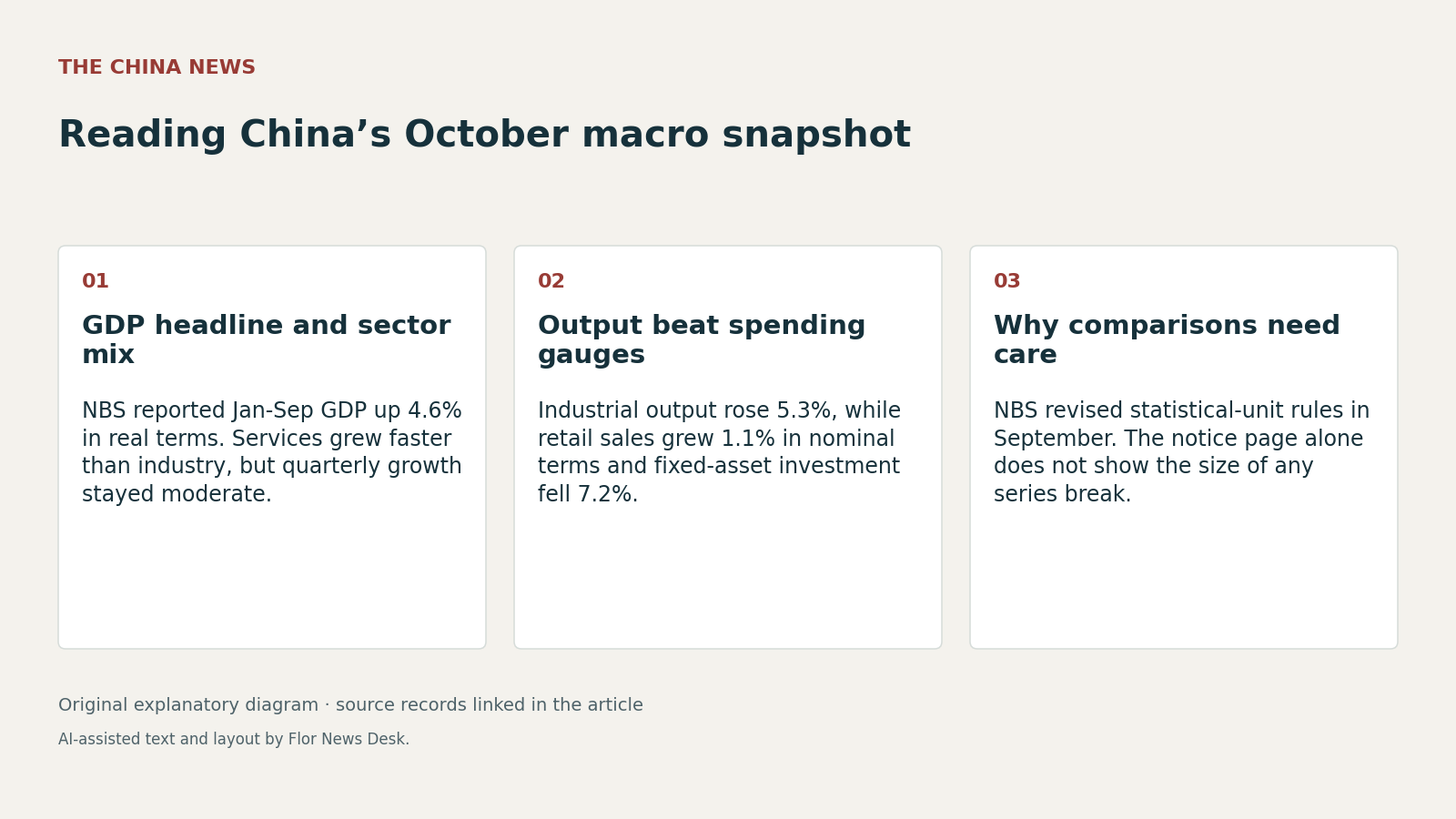

Beijing’s latest official macro snapshot arrived on 19 October 2026, when the National Bureau of Statistics said China’s gross domestic product for January to September reached 107,107.1 billion yuan, up 4.6% year on year at constant prices. The bureau said first-quarter growth was 5.0%, second-quarter growth 4.3%, and third-quarter growth 4.5%, with third-quarter GDP up 1.2% quarter on quarter after seasonal adjustment. Its sector split showed services growing faster than industry: tertiary-industry value added rose 5.2%, compared with 3.8% in the secondary industry and 3.7% in the primary industry. NBS English release
That headline does not, by itself, show a broad domestic-demand recovery. In the same release, NBS said total retail sales of consumer goods rose 1.1% in January to September and fixed-asset investment excluding rural households fell 7.2%, while consumer prices rose 0.9%. The release notes matter here: NBS says GDP and industrial value added are real measures, while many other indicators are nominal unless specified. That means GDP and retail are not a like-for-like comparison. Even so, the combination is enough to show that output growth and weak spending indicators coexisted through September. NBS itself said insufficient domestic demand remained a prominent issue. NBS English release
The strongest detail in the October package came from industry rather than shops. NBS said value added of industrial enterprises above the designated size rose 5.5% in September and 5.3% in January to September, both in real terms. Within that, high-technology manufacturing rose 15.3% in September, while output of new-energy vehicles reached 1.87 million units and integrated circuits 54.3 billion units. But this series covers only industrial firms with annual main business revenue of 20 million yuan or more. It is therefore evidence of strength among larger producers, not a census of the whole economy and not a direct measure of household demand. Industrial release
Retail detail points to a narrower picture than the GDP headline alone. NBS said January-September sales excluding automobiles rose 2.8%, better than the 1.1% headline. Urban retail sales rose 0.9% and rural sales 2.3%; goods retail rose 1.0% and catering revenue 2.4%. Nationwide online retail of goods and services rose 4.4%. Among above-quota units, communication equipment sales rose 18.1%, while automobile sales fell 14.9% and household appliances and audio-video equipment fell 4.9%. That mix suggests some areas of spending held up better than big-ticket goods, without proving a broad rebound in household consumption. The release also states that retail measures goods sales and catering revenue, not total household consumption or wider services demand. Retail release
An external benchmark broadly points the same way, but on a different basis. In a 6 October 2026 regional press release, the World Bank said China is growing at 4.4% in 2026 and attributed constrained domestic demand to a soft labor market and continuing property-sector adjustment. That is not directly comparable with NBS’s January-September national-accounts update: one is an institutional forecast for the year, the other an official partial-year result. Still, the proximity between 4.4% and 4.6%, together with both institutions’ references to demand constraints, supports a cautious reading rather than a clear growth reacceleration story. The World Bank also said some regional economies were benefiting from high-technology manufacturing exports tied to AI-related demand, which fits the direction of China’s industrial data without proving the same mechanism. World Bank release
A final caveat is statistical, not cyclical. On 10 September 2026, NBS published a notice issuing revised 《统计单位划分及具体处理办法》, dated 4 September, saying the revision was meant to strengthen statistics based on where business activity occurs, standardize statistical units and improve data quality. But the retrieved notice page only lists attachments; it does not establish the specific rule changes, their quantitative effect on current series, or whether the 19 October releases already reflect a measurable break. Separate NBS notes also warn that changes in reporting units, online-platform coverage and the removal of some cross-region duplicate output affect comparability. Readers can use the 4.6% figure as the newest official snapshot, but not as a clean verdict on whether China’s demand weakness has been resolved. NBS rule notice NBS English release