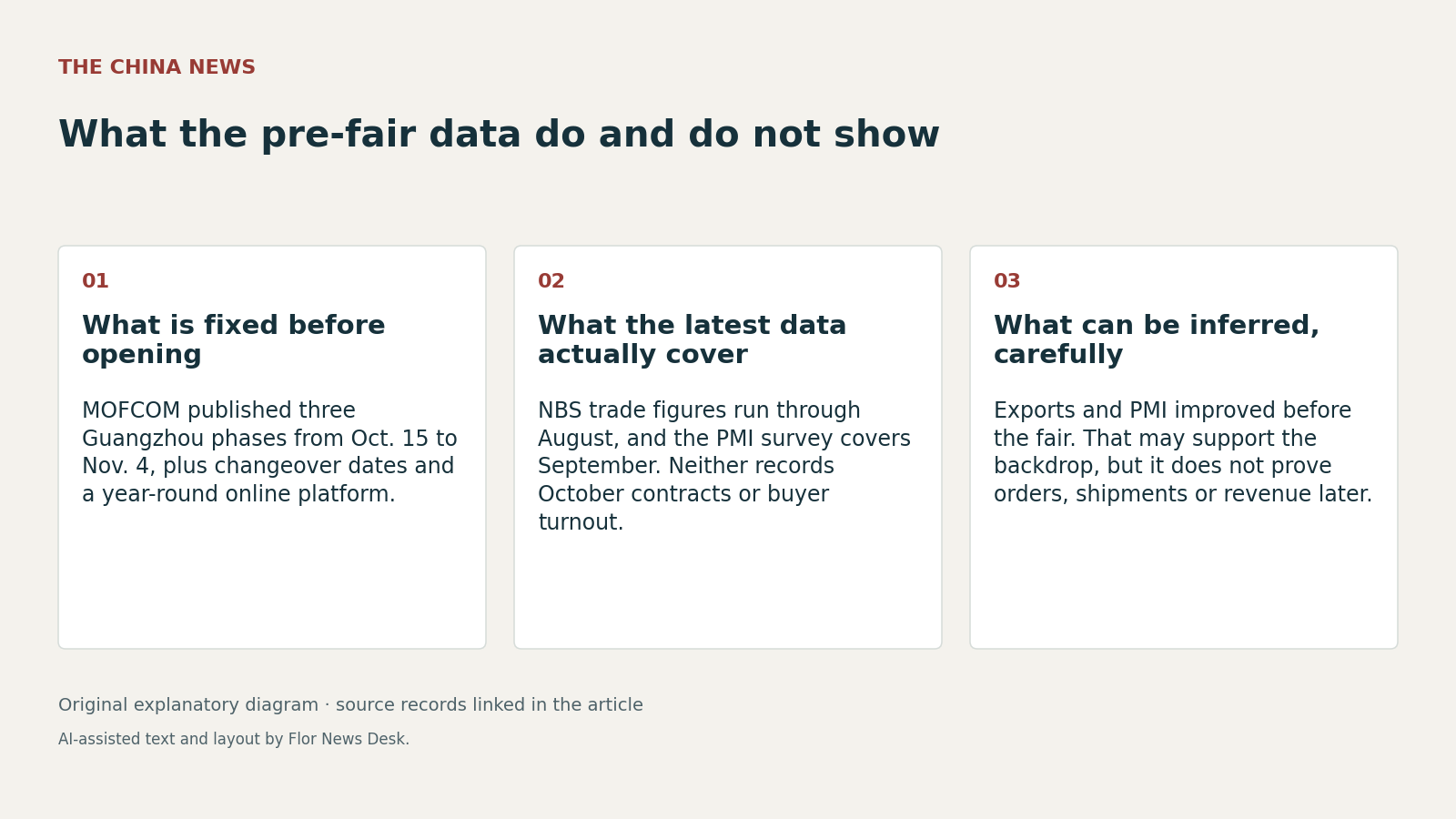
The 140th China Import and Export Fair is scheduled to open in Guangzhou on Oct. 15, with three onsite phases running through Nov. 4, according to a Ministry of Commerce introduction published on July 24. The ministry lists Phase 1 for Oct. 15-19, Phase 2 for Oct. 23-27 and Phase 3 for Oct. 31-Nov. 4, with changeover intervals in between; it also says the fair’s website and app operate year-round alongside the physical event (MOFCOM introduction). Five days before opening, that timetable is the clearest fixed part of the story. What it does not establish is how much business the fair will actually generate.
That distinction matters because the official statistical backdrop has improved. In a Sept. 15 release covering August data, the National Bureau of Statistics said China’s goods trade in August reached 46,455亿元, up 19.8 percent year on year, with exports at 27,274亿元, up 18.6 percent. For January through August, the same release reported exports of 201,658亿元, up 14.6 percent, and said electromechanical product exports rose 21.9 percent (NBS Aug. data release). That gives the Guangzhou fair a stronger national trade backdrop than a weaker summer reading alone would suggest.
The fair’s own structure makes that macro picture relevant, but only up to a point. MOFCOM says the event will cover about 1.55 million square metres, and that Phase 1 will focus on advanced manufacturing, Phase 2 on quality home life and Phase 3 on better life. The ministry also says it expects more than 30,000 enterprises to participate, including about 2,800 brand exhibitors (MOFCOM introduction). Because those participation figures were published before the fair opens, they remain plans rather than verified attendance. Still, the Phase 1 emphasis on manufacturing sits broadly alongside the national export data showing faster growth in electromechanical shipments. That is an analytical overlap, not proof that the fair’s first phase will convert into orders.
A second official signal came later in the month. On Sept. 30, the National Bureau of Statistics Service Industry Survey Center and the China Federation of Logistics & Purchasing said the September manufacturing PMI was 50.1, up 0.3 points from August, while the new orders index was 50.5 and the supplier delivery time index was 50.1. The new export orders index was exactly 50.0, while raw materials inventories and employment remained below 50 (NBS September PMI release). Read carefully, that is a picture of stabilization, not unambiguous strength. The survey moved back above the 50 line, but not by much, and some underlying components stayed soft.
Taken together, the records support a narrower conclusion than an upbeat pre-fair narrative might imply. National export values through August and a September PMI rebound suggest conditions were better than a simple slowdown story would indicate. But those releases cover different things: customs-based trade values through August, and a September diffusion survey of business conditions. Neither document measures October buyer arrivals in Guangzhou, contract values signed at the fair, later cancellations, or when any resulting shipments would be booked.
That leaves the fair as a test of transmission rather than a measured result. If Guangzhou sees strong overseas attendance and substantial deals across the three phases, the event could reinforce the national data. If turnout or order quality disappoints, the same macro releases will not have been wrong; they will simply have described a broader economy on dates earlier than the fair itself. Before Oct. 15, the strongest evidence is that the Canton Fair is opening into a somewhat firmer official trade and survey environment, while the most important commercial outcomes are still unproven in the public record.