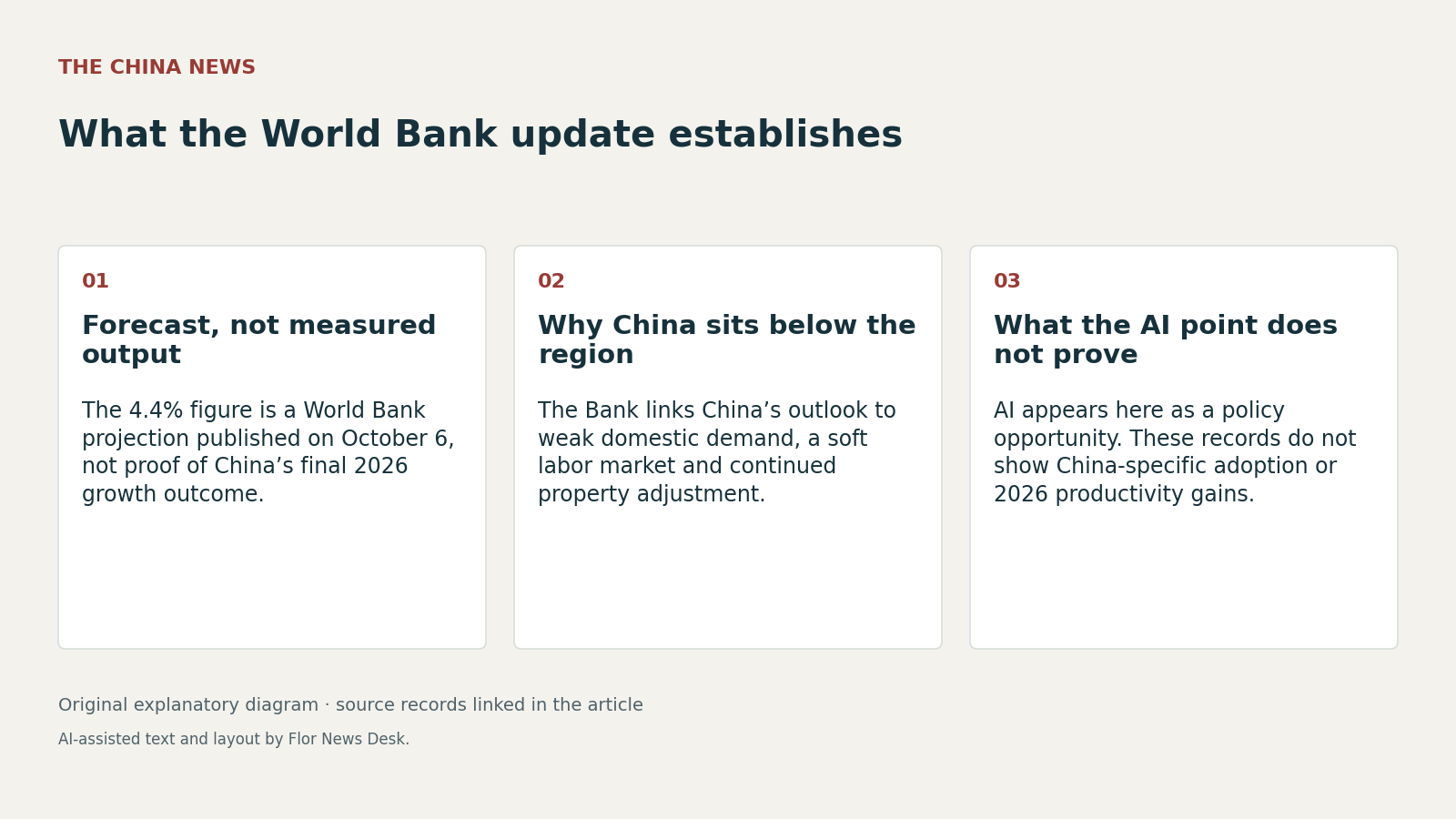

In the World Bank’s East Asia and Pacific update published on October 6, China is assigned 4.4% growth for 2026, slightly below the region’s projected 4.5% pace in the same release World Bank press release. For China readers, the immediate point is narrow but important: this is a newly published forecast in a regional document, not evidence that China has already achieved 4.4% growth in 2026.
The release also gives a clear reason for the lower China figure. The World Bank ties the outlook to constrained domestic demand, a soft labor market and continuing adjustment in the property sector World Bank press release. That diagnosis is notable less because it is new than because it is consistent with the Bank’s broader China description elsewhere. On the World Bank’s China country page, the economy overview lists a prolonged property-sector downturn, weak confidence, deflationary pressure from weak domestic demand and uncertainty from changing global trade policies World Bank China page. The available records therefore point to continuity in the Bank’s concerns, not a sudden October rethink.
That continuity matters when reading the 4.4% number. The same country page includes a research card for “China Economic Update - Rebalancing Growth.(July 2026)” that also projected 4.4% growth in 2026 and 4.3% in 2027 World Bank China page. Based on these records alone, October 6 looks like a fresh regional publication of an already visible China estimate, not documented proof of a revision up or down. The sources here do not provide the technical note, model assumptions or confidence ranges needed to show whether the Bank changed its internal view between July and October.
The release’s AI language should be read with the same care. The World Bank says a regional AI analysis found uneven adoption, and it highlights that only 13% of jobs in East Asia and the Pacific require complex thinking and judgment, versus 39% in advanced economies World Bank press release. That supports a policy argument that the region could gain by improving how firms and workers use AI. It does not, on this source record, demonstrate that AI is already lifting China’s 2026 productivity, employment or household demand. No China-specific adoption benchmarks, sector breakdowns or measured output effects are supplied in the retrieved documents.
The World Bank’s own country material reinforces the need to separate dated data points from forecasts. The China page says real GDP grew 5.3% year on year in the first half of 2025 World Bank China page. That is a backward-looking statistic for a different period, while the 4.4% figure is a forward-looking estimate for full-year 2026. They are not contradictory, but they are not the same type of evidence. The country page also has no explicit page-wide publication date, so its figures should be treated as mixed background material rather than as one single October 2026 statement.
A final limit is what other retrieved records cannot add. The IMF link available in this source set leads to an “Exchange Rate Report Wizard” page whose captured content is mostly navigation, without a usable China-specific table or dated assessment IMF page. That means the source record here can explain the World Bank forecast and its framing, but it cannot independently test the forecast against a parallel IMF reading. The safest conclusion is therefore limited: on October 6, the World Bank publicly restated a cautious near-term China outlook and paired it with an aspirational AI agenda whose practical China payoff remains unshown in the documents at hand.