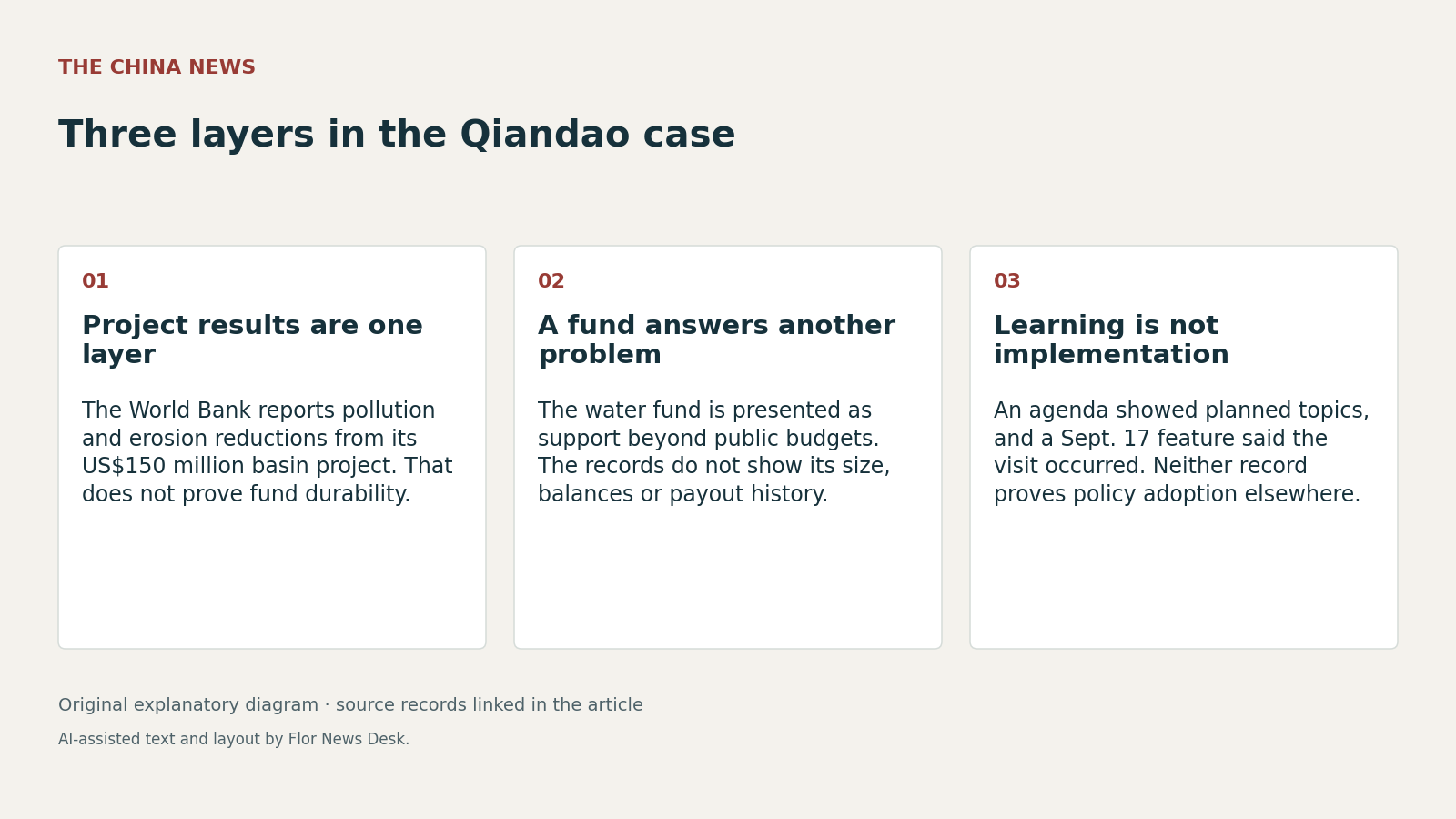
The September 7-11, 2026 knowledge exchange that included a stop at Qiandao Lake in Zhejiang matters less as a diplomatic tour than as a test of how readers separate three claims that are often blended together: a restoration project achieved certain results, a conservation fund can keep support flowing after construction, and officials from elsewhere may learn something useful from the site. The World Bank reported on September 17 that the exchange occurred and brought together about 30 senior government representatives from 15 countries, after an earlier agenda had described what organizers expected to show there World Bank retrospective, Sept. 17 World Bank agenda.
The first layer is physical restoration. In an August 3 feature, the World Bank said a US$150 million World Bank-financed project has operated since 2018 in Qiandao Lake and its catchment under the name Qiandao Lake and Xin'an River Basin Water Resources and Ecological Environment Protection Project. The same record said that by project close, nitrogen and phosphorus loads flowing into the lake had fallen by more than 25% and 31%, more than 13,600 hectares of degraded and denuded forest had been restored, and soil erosion across the watershed had fallen by more than 23% World Bank feature, Aug. 3. Those are outcome claims about a financed project. They are not, by themselves, evidence that the next decade of maintenance has been funded.
That is where the second layer begins. The August 3 feature said the project, working with The Nature Conservancy, created the Qiandao Lake Water Fund to connect upstream and downstream stakeholders and direct investment toward small-watershed resilience and local environmental protection World Bank feature, Aug. 3. The September 17 retrospective went further, presenting the fund as a way multi-stakeholder financing can support conservation beyond public budgets alone World Bank retrospective, Sept. 17. That is the core reason the fund matters beyond the restoration budget: it addresses continuity, not just initial works. But the available records do not state the fund’s size, contributors, balances, payout history or long-term durability. So the evidence supports the fund’s institutional purpose, not its proven solvency.
The third layer is policy learning across catchments. The agenda page, which still uses future tense even though September 7-11 had already passed by the current date, is useful only as a record of planned sessions. It scheduled a September 10 field visit to the Xiaowudu watershed restoration site and listed intended topics including hedgerows, sustainable hickory management, lakelet wetland restoration, and the fund’s governance and payments for ecosystem services World Bank agenda. The September 17 feature is the document that says participants did visit Qiandao Lake sites and produced an action note, with follow-up sessions intended afterward World Bank retrospective, Sept. 17. That establishes exposure, not adoption.
Taken together, the three World Bank records suggest a disciplined way to judge similar Chinese environmental showcases. First ask whether the measured project results are clearly dated and independently checked. Second ask whether any financing vehicle has documented inflows and outflows after the capital project phase. Third ask whether visiting officials merely observed a model or later changed rules, budgets or land management in their own jurisdictions. On the present source record, Qiandao Lake offers a concrete Chinese case of restoration linked to an attempt at continuing conservation finance, and then linked again to international learning. What it does not yet offer is source-backed proof that the fund’s long-run finances are secure or that another country has implemented the approach.