On 1 April 2021, the World Bank published a results account of the Anhui Yellow Mountain New Countryside Demonstration Project in 68 villages in Huangshan, Anhui, describing work carried out from 2013 to 2020. Read alongside a 22 March 2017 World Bank blog that framed heritage-led development as conservation plus infrastructure, housing and social inclusion, the Huangshan case is most useful as a historical reminder that village services belong inside the heritage story, not beside it. World Bank results brief World Bank blog commentary
The conservation side is easy to see. The results account says more than 58,000 square meters of historic buildings were restored and about 300 tourism facilities were built. Those figures speak to protecting historic fabric and making it legible to visitors. But they answer only one question: what was preserved. They do not, on their own, establish whether residents could keep using those places as functioning villages rather than as carefully repaired scenery. World Bank results brief
The same record gives a second set of measures that point in a different direction. According to the World Bank, more than 136,000 people were within 500 meters of all-season roads, more than 35,000 gained improved water sources, and more than 24,000 gained improved sanitation. It also says tap-water coverage rose by 16 percent and centralized wastewater treatment coverage rose from 11 percent to 46 percent in project villages. These are not ornamental extras to a heritage plan. They are the conditions under which a historic settlement remains usable for the people who live there. World Bank results brief
That is where the 2017 commentary helps, even with its limits. In that earlier World Bank post, official Ede Ijjasz-Vasquez presented heritage-led development as a package that includes infrastructure upgrading, housing upgrading and social inclusion, while the institution argued that sustainably managed tourism can improve livelihoods in poorer areas. Because the post predates Huangshan’s later results, it is evidence of institutional framing rather than proof of what happened in Anhui after 2017. Still, the project mix later described for Huangshan, including public services, agriculture support, skills training and local government capacity building, fits that broader conception of heritage work. World Bank blog commentary World Bank results brief
The economic numbers need the same separation. The results account says annual visits to project villages rose 78 percent to more than 3.7 million by 2019, that 4,565 local jobs were created, that more than 4,800 farmers received agricultural training, and that village per capita net income rose 12.4 percent annually from 2013 to 2019. Those are reported outcomes, but the source record does not isolate which share came from restored heritage, which from tourism facilities, and which from roads, sanitation, agriculture or training. Nor do village-level visitor and income totals show how gains were distributed across households. World Bank results brief
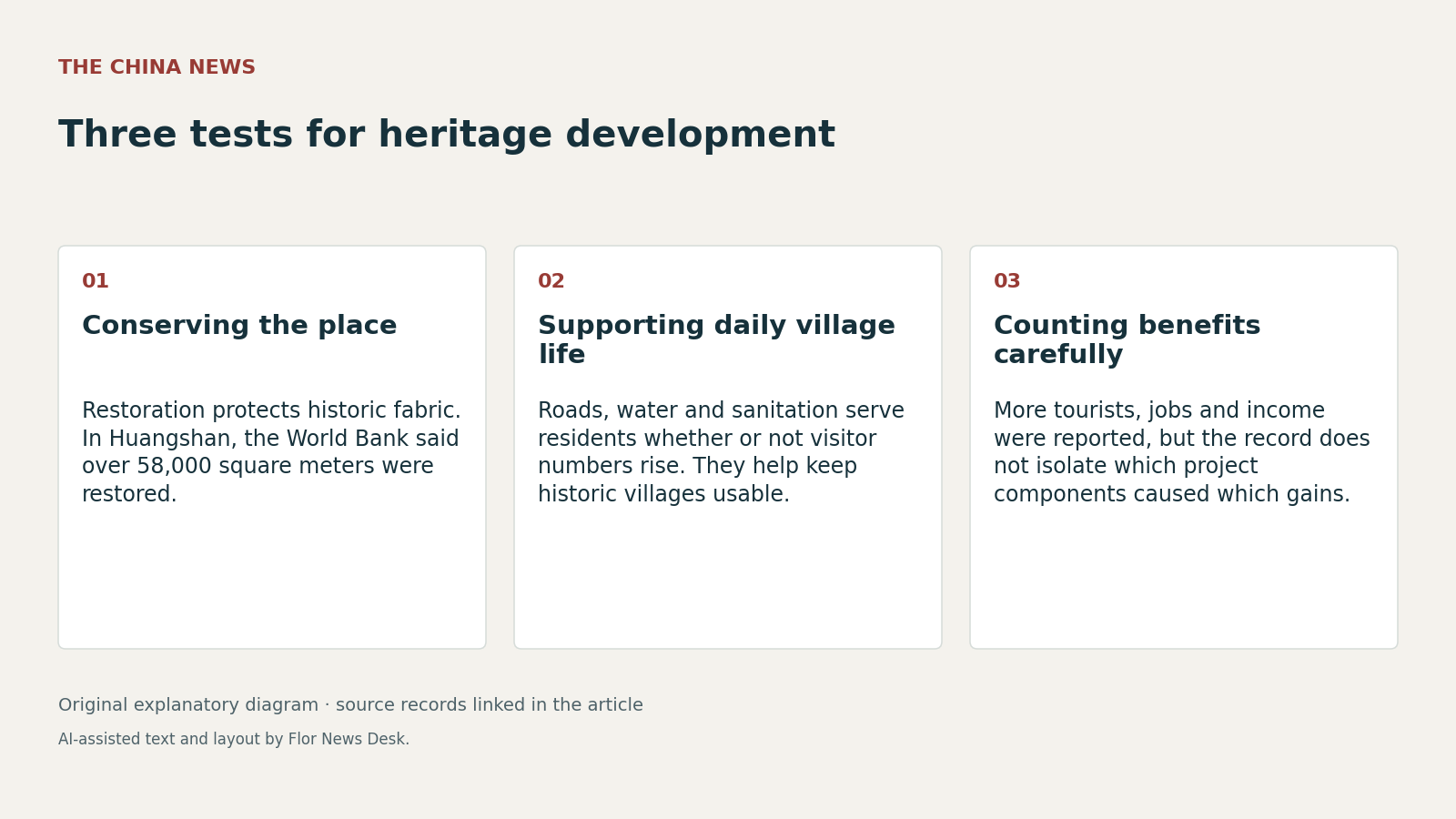
That limitation is the main reason this dated case still has analytical value on 21 September 2026. A heritage programme can be judged along at least three tracks: whether it conserved historic assets, whether it improved daily services for residents, and whether it widened economic opportunity. The World Bank’s Huangshan material suggests all three were pursued together. Its own documentation is not enough to prove that progress on one track automatically delivered progress on the others. For readers assessing similar claims, that is the most useful distinction the record supports. World Bank results brief World Bank blog commentary