In China, the useful signal in the World Bank’s 7 July 2026 economic update is not just that the low-carbon transition is changing work. It is that the Bank said rising demand covers both technical abilities and transferable competencies, and that this demand reaches beyond narrowly defined low-carbon sectors (World Bank China Economic Update press release). That framing matters because a sector label can tell readers where an employer sits in the transition, but not what a worker actually has to do.
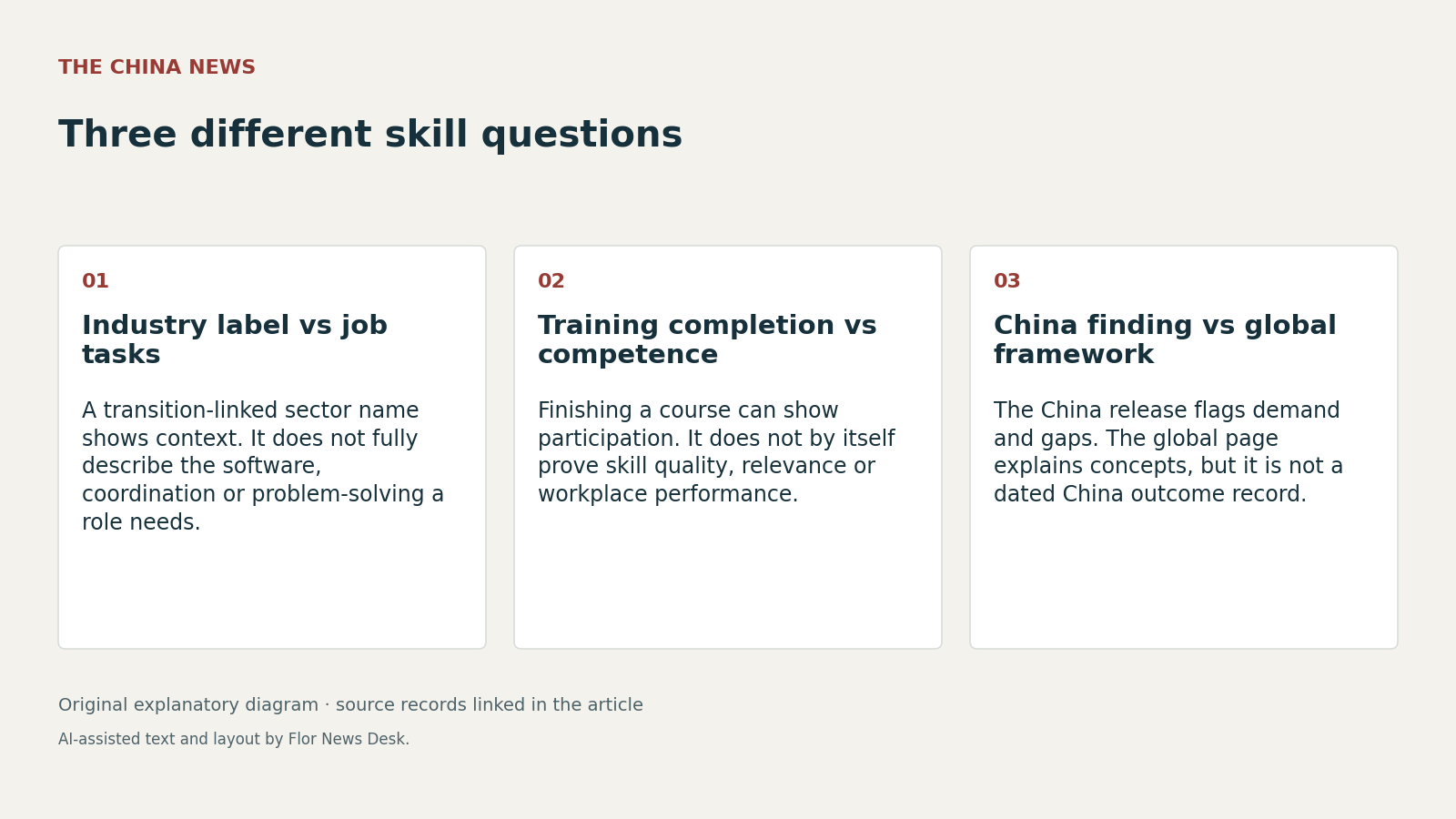
That is the first distinction. “Green industry” is a classification question; skills are a task question. If the Bank is right that employers are seeking capabilities such as systems thinking, adaptive learning and digital skills outside a tight low-carbon category, then the labour-market issue is wider than counting jobs inside solar, wind or electric-vehicle supply chains (World Bank China Economic Update press release). Analysis: a role can be tied to the transition because of what it supports, while still requiring many of the same cross-sector competencies found elsewhere in manufacturing, logistics or services.
A hypothetical example shows why the label is incomplete. Imagine a scheduler at a factory that supplies components to a renewable-energy project. The role may sit inside a transition-linked business, but the immediate tasks could still be production planning, software use, troubleshooting and coordination across teams. Those are not erased or fully described by calling the job green. The reverse is also possible in logic: a worker outside a narrowly labelled green sector may still need the same digital and adaptive competencies if their tasks are changing for climate-related reasons. That is an analytical example, not evidence about any named Chinese employer.
The second distinction is between needing a competency and proving that a person has it. The World Bank’s general skills page treats skills as a broad bundle, including cognitive, socio-emotional, specialized technical, entrepreneurial and digital elements, and it presents digital skills as cross-cutting across transitions (World Bank Skills and Workforce Development overview). The same page separately identifies access and completion, adaptability, quality assurance and labour-market relevance as distinct issues (World Bank Skills and Workforce Development overview). That separation is important: finishing a course is not the same thing as demonstrating job-ready capability, and a valid competency signal is not the same thing as simply attending training.
The third distinction is between an announced finding and a measured outcome. The China press release says these skills carry wage premiums and that skill gaps are limiting inclusive employment gains, but the retrieved record does not provide the size of any premium, methods, occupation-level tables, sector breakdowns or evidence on who completed training and then got hired (World Bank China Economic Update press release). The global skills page, meanwhile, is undated and not China-specific, so it cannot establish current Chinese training performance or policy implementation as of 21 September 2026 (World Bank Skills and Workforce Development overview).
That leaves a narrower but more useful conclusion. The World Bank’s July statement supports the idea that China’s green-transition skills question extends beyond industry labels. It does not, on this source record alone, show which occupations changed first, which credential best signals competence, or whether a given training programme improved employment outcomes. For readers, the sharper question is therefore not “Is this a green job?” but “What tasks are changing, what capabilities travel across sectors, and what evidence shows those capabilities were actually learned?”