The World Bank’s China overview can look contradictory at first glance. On the same page, the institution says China had eradicated extreme poverty by 2020 and also reports that 15.2 percent of the population lived on less than $8.30 a day in 2024, measured in 2021 purchasing power parity terms World Bank China overview. Read carefully, those are not rival verdicts on one line. They are two different poverty statements using different benchmarks.
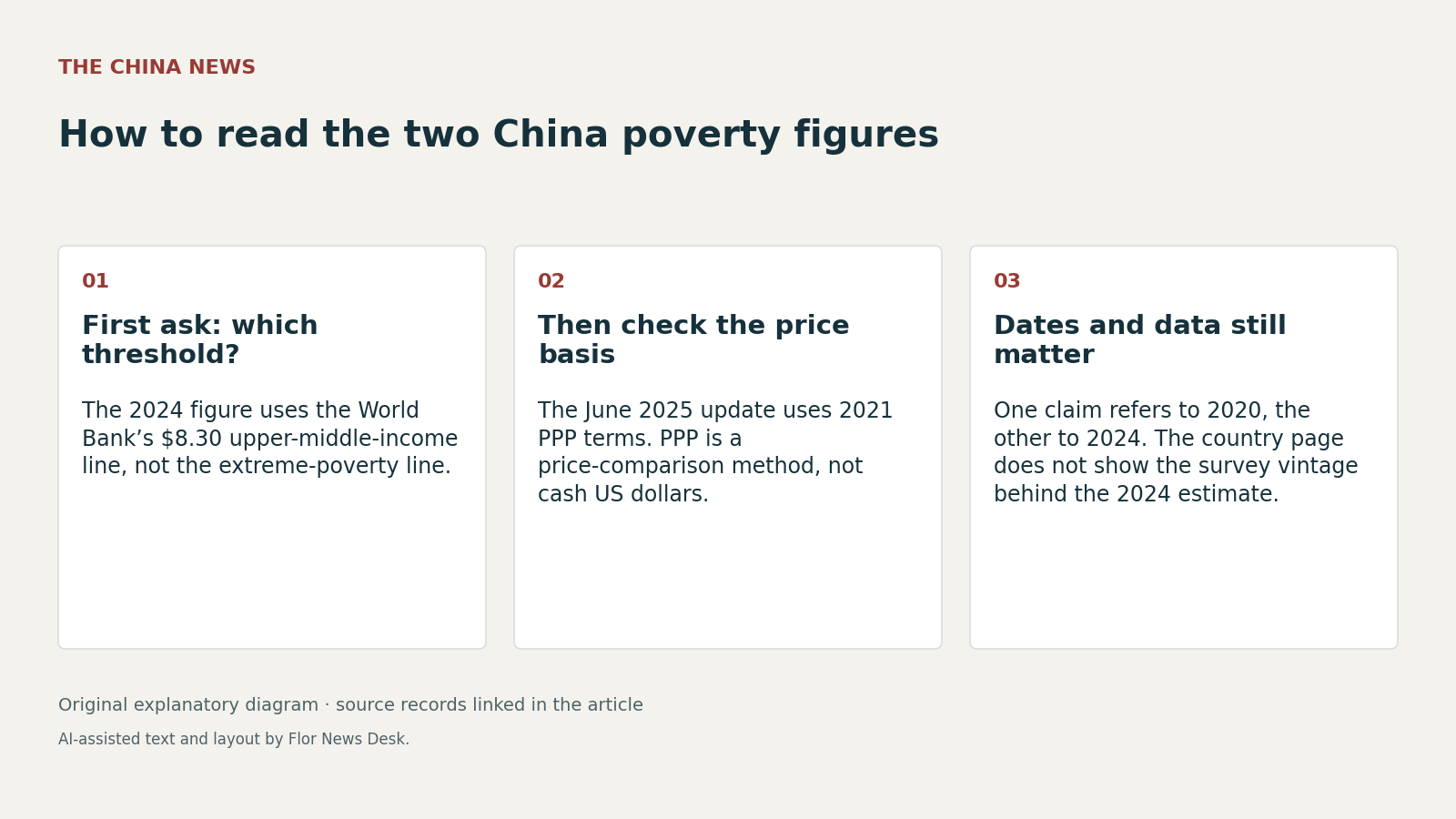
The first label is the threshold itself. The World Bank’s June 5, 2025 methodology update says its international extreme-poverty line is now $3.00 per person per day in 2021 PPP terms, while the upper-middle-income poverty line is $8.30 June 2025 update to global poverty lines. The China overview identifies the 2024 figure as the higher $8.30 benchmark used for cross-country comparison, not as the extreme-poverty line World Bank China overview. That distinction matters because a country can report no one in extreme poverty under one standard while still having a larger share below a higher living-standard threshold.
The second label is the price basis. The June 2025 factsheet says the revised lines use 2021 purchasing power parities released by the International Comparison Program in May 2024 June 2025 update to global poverty lines. PPP dollars are a comparison tool, not cash US dollars at a market exchange rate. So the $8.30 figure should not be read as if it were an amount Chinese households literally receive or spend in US currency. It is a way of making living-standard comparisons across economies after adjusting for relative prices.
The third label is the reference year. The China page ties one statement to 2020 and the other to 2024 World Bank China overview. Even before any methodological issue, those dates describe different moments. The fourth label is the survey or data vintage behind the estimate. Here the source record is incomplete. The country page does not show a publication date, is mixed-vintage material as retrieved on September 21, 2026, and does not state the survey basis for the 2024 poverty figure World Bank China overview. That means readers can see the reported result, but not the full chain of underlying data from that page alone.
This is also why the 2020 statement should not be silently rewritten as a result under the post-2025 $3.00 line. The overview says only that by 2020 China had eradicated extreme poverty World Bank China overview. The methodology note explains that the international line was revised in June 2025 from $2.15 in 2017 PPP terms to $3.00 in 2021 PPP terms June 2025 update to global poverty lines. Without a China-specific bridge in the source record, that update does not by itself prove how the earlier 2020 claim maps onto the newer line.
The World Bank’s own methodological hierarchy points in the same direction. Its factsheet says national poverty lines are the appropriate standard for judging poverty levels and trends within a single country and for domestic policy targeting June 2025 update to global poverty lines. But the sources here do not provide China’s national poverty line. So the safest reading is narrow: the overview presents one World Bank claim about extreme poverty by 2020 and another about the share below the higher $8.30 benchmark in 2024, while the factsheet explains why revisions to PPPs, lines and surveys can change measured poverty without altering people’s day-to-day living conditions June 2025 update to global poverty lines.
For readers, the practical rule is simple. Before comparing any two poverty numbers for China, check four labels: threshold, price basis, reference year and survey or data vintage. If any of those differ, the figures may still be useful, but they are not a like-for-like trend line. In this case, the source record supports a methods explainer, not a claim that poverty rose between 2020 and 2024.