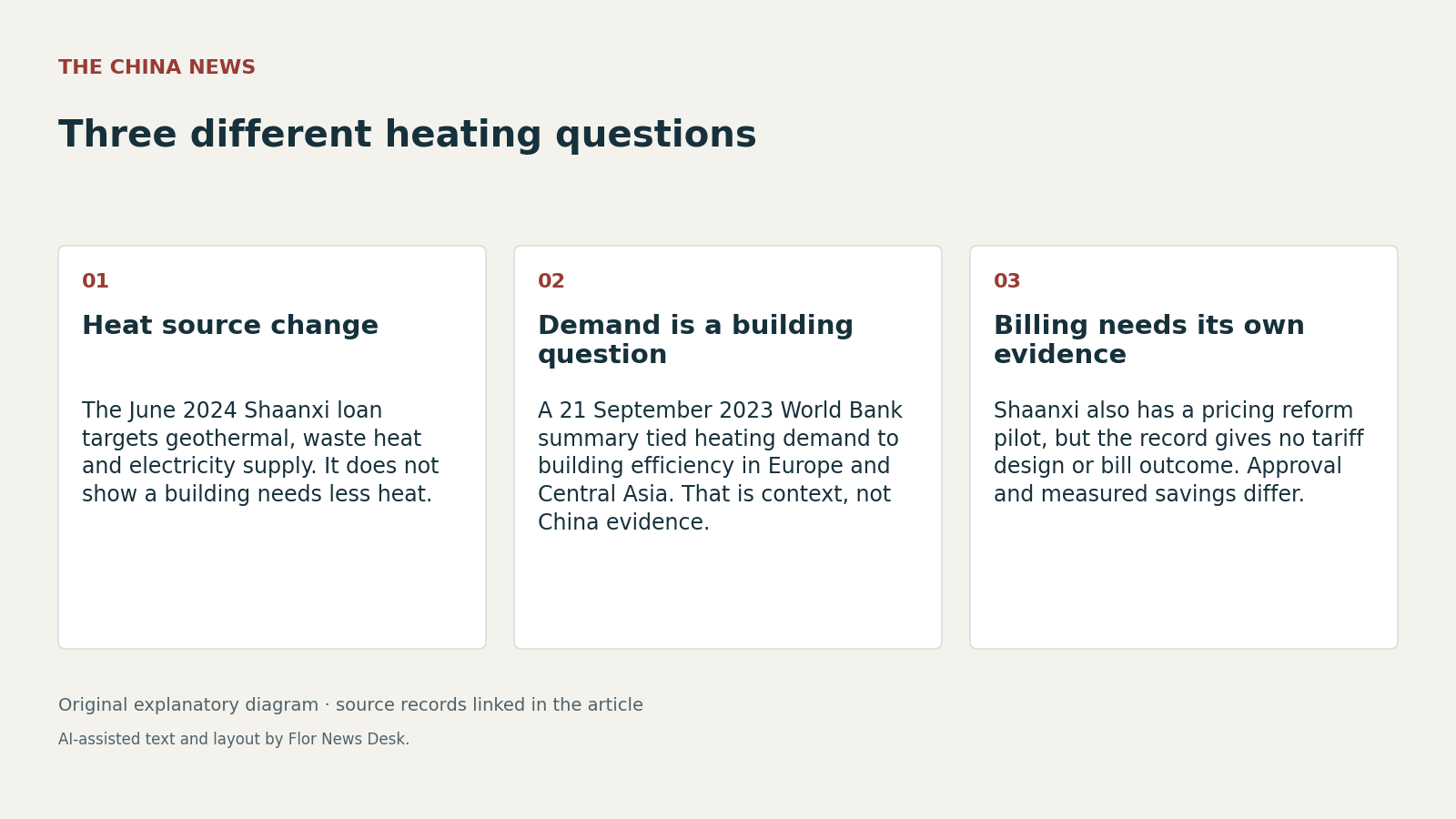
On June 28, 2024, the World Bank said its Board of Executive Directors approved a US$300 million loan for Shaanxi’s Shaanxi Energy Transition and Innovation Demonstration in the Heating Sector Project World Bank press release, June 28 2024. The announcement joins two ideas that are often blurred together: changing where heat comes from, and changing how heating service is priced. Neither point, in that record, establishes that a named building used less energy or that households paid less after reform.
The cleaner-supply part is the clearest. The World Bank said the Shaanxi project is intended to increase heat supply from renewable and low-carbon sources, including geothermal, waste heat and electricity, and that financing would support related infrastructure World Bank press release, June 28 2024. That matters for the carbon profile of delivered heat. But it does not answer a different question: how much heat a building actually needs. A cleaner source can still serve an inefficient building.
That distinction appears more clearly when set beside a separate World Bank release dated September 21, 2023, about 23 countries in Europe and Central Asia World Bank press release, September 21 2023. In that external context, the institution linked heating affordability partly to aging, energy-inefficient buildings and said stronger construction standards and faster renovation of existing buildings could reduce heating demand World Bank press release, September 21 2023. Those are concepts from another region, not evidence about Shaanxi. Still, they help separate a demand question from a supply question.
Billing is a third issue. In the Shaanxi case, the World Bank said the project also supports a pricing reform pilot and the process of designing and implementing it World Bank press release, June 28 2024. The available record does not say what charging method would be tested, which users would be covered, or whether any household bill would rise or fall. That gap matters because service charges are not the same thing as fuel mix. As a hypothetical example, two homes could use the same amount of heat yet receive different bills under different pricing rules; that logic does not prove anything about Shaanxi’s pilot design.
The financing language also needs careful reading. The June 2024 release says five-year financing needs are estimated at US$585 million, with US$300 million from an International Bank for Reconstruction and Development loan and the remainder from Chinese counterparts World Bank press release, June 28 2024. That is an approval and a plan for funding, not evidence that all money was received, infrastructure was completed, or reform was operating by September 21, 2026.
The useful conclusion is narrow. The Shaanxi announcement supports a cleaner-heat direction and a reform process. The September 2023 Europe and Central Asia summary shows, from outside China, why building efficiency is a separate policy lever World Bank press release, September 21 2023. To show lower energy use, lower bills or improved affordability in Shaanxi would require later records on implementation, the actual pricing model adopted and measured results. These two releases do not provide that proof.