In Yichang, Hubei, the World Bank’s 31 May 2024 financing announcement is best read as a statement of what a low-carbon mobility program intended to measure, not as proof of what it achieved. The Bank said its Board approved a US$250 million International Bank for Reconstruction and Development loan for a five-year program in Yichang City and listed three expected results: higher average daily public transport ridership, better accessibility to jobs within 60 minutes using green modes, and lower net greenhouse gas emissions. The same page gave no baseline, target value, service-area definition or calculation method for those indicators, so as of 21 September 2026 it still cannot establish delivery. World Bank press release
The useful comparison is therefore not Yichang versus Zhengzhou as a city ranking. It is the difference between an approval document and a results account. The World Bank’s Zhengzhou page reports observations tied to Urban Rail Line 3 after it opened in December 2020: daily ridership of 140,000 passenger-trips in June 2021, an estimated 33,960 tons of CO2 mitigated in 2021, and one corridor example where a bus trip from Provincial Orthopedic Hospital to Erqi Plaza took 65 minutes before the line and 25 minutes on Line 3. Those are measured or estimated outcomes for specific dates and places, even though the page does not show the underlying methods. World Bank results page
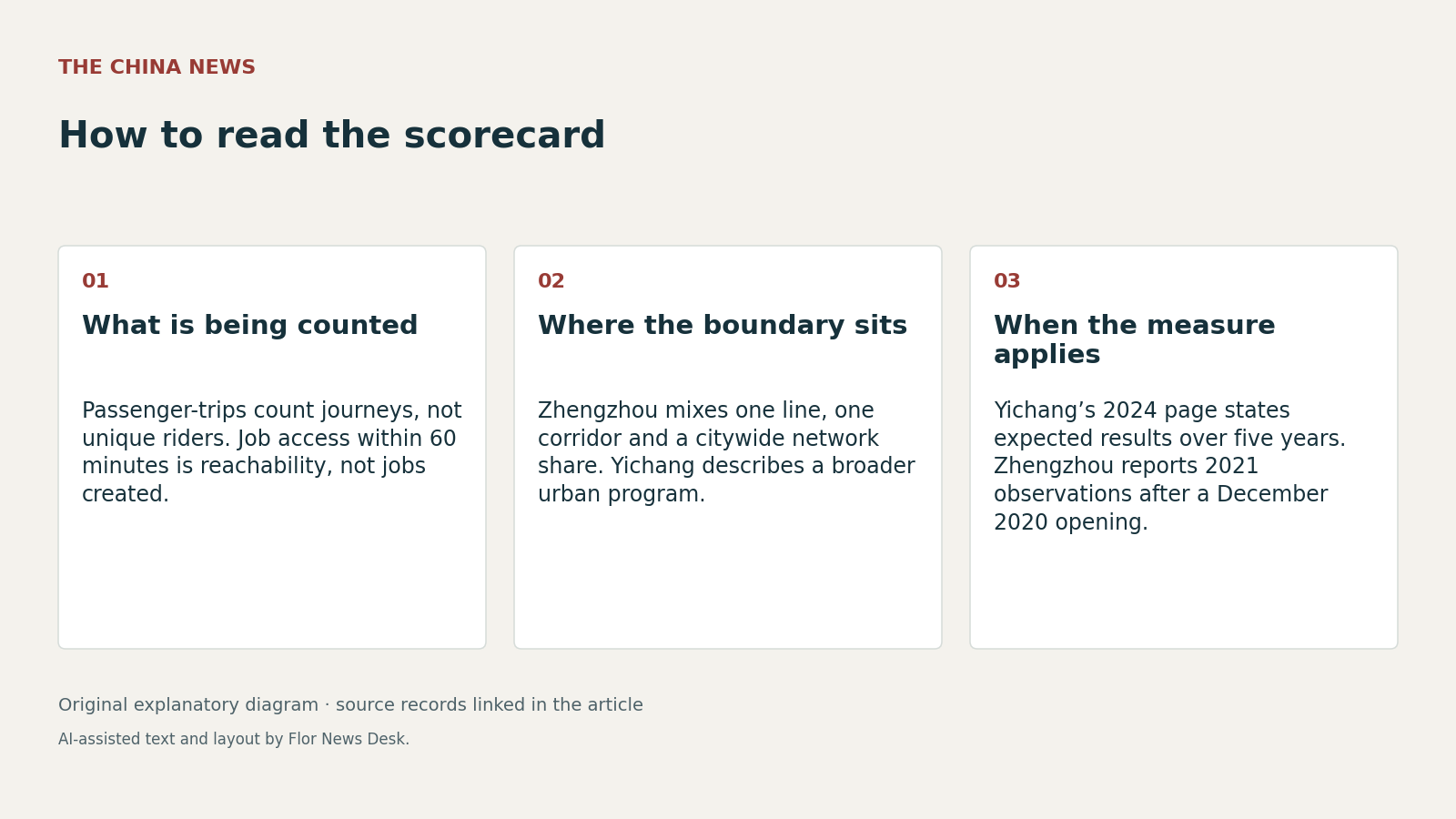
The first reading question is what exactly is being counted. Passenger-trips count journeys, not distinct people. A hypothetical commuter who rides to work and back creates two passenger-trips in one day without implying two riders. Accessibility to jobs within 60 minutes asks a different question: how many jobs can be reached within a time limit by specified modes. That does not equal jobs created, filled or accepted. Net greenhouse gas emissions are different again, because the Zhengzhou page presents an estimate for 2021 rather than a direct emissions reading. Treating these as interchangeable would blur three separate policy claims. World Bank press release World Bank results page
The second question is where the boundary of each measure sits. Zhengzhou’s page mixes three scales. Line 3 is a 25.2-kilometer urban rail line linking the city center with northwestern and southeastern districts. The 65-minute to 25-minute comparison concerns one origin-destination pair, while the 43.7 percent share of all public transport trips in the first half of 2021 refers to a broader urban rail network with seven lines in operation, compared with 18 percent in 2017 when two lines were operating. Yichang’s approved program, by contrast, spans cleaner vehicle emission standards, retirement of older freight vehicles and buses, development that prioritizes public transit, walking and cycling, improved parking management, and a pilot for transport-sector participation in an emissions trading scheme. A citywide program can improve access without that change appearing on one route, just as one busy line can raise trip counts without proving citywide job access changed. World Bank results page World Bank press release
The third question is when the measure applies. The Yichang page is forward-looking from 31 May 2024 and says total program financing is estimated at US$1.114 billion over five years, with the remainder beyond the World Bank loan coming from the Chinese government. That is an announced funding plan, not a record of money already received or spent. The Zhengzhou page, by contrast, combines June 2021 ridership, first-half 2021 mode share and a 2021 carbon estimate after the line’s December 2020 opening. Those dates matter because a six-month ridership figure, a half-year network share and a full-year emissions estimate are not interchangeable snapshots. World Bank press release World Bank results page
Read together, the two documents offer a better scorecard vocabulary than a head-to-head verdict. Yichang asks whether a broader package can change trips, access and emissions over time. Zhengzhou shows how one results brief can contain trip counts, a route example and a modelled climate effect in the same story. The disciplined reading is to separate count, boundary and period before drawing conclusions. Without that, a larger number of recorded trips can be mistaken for more people served, and an accessibility gain can be mistaken for jobs gained, even though the documents do not make either claim. World Bank press release World Bank results page