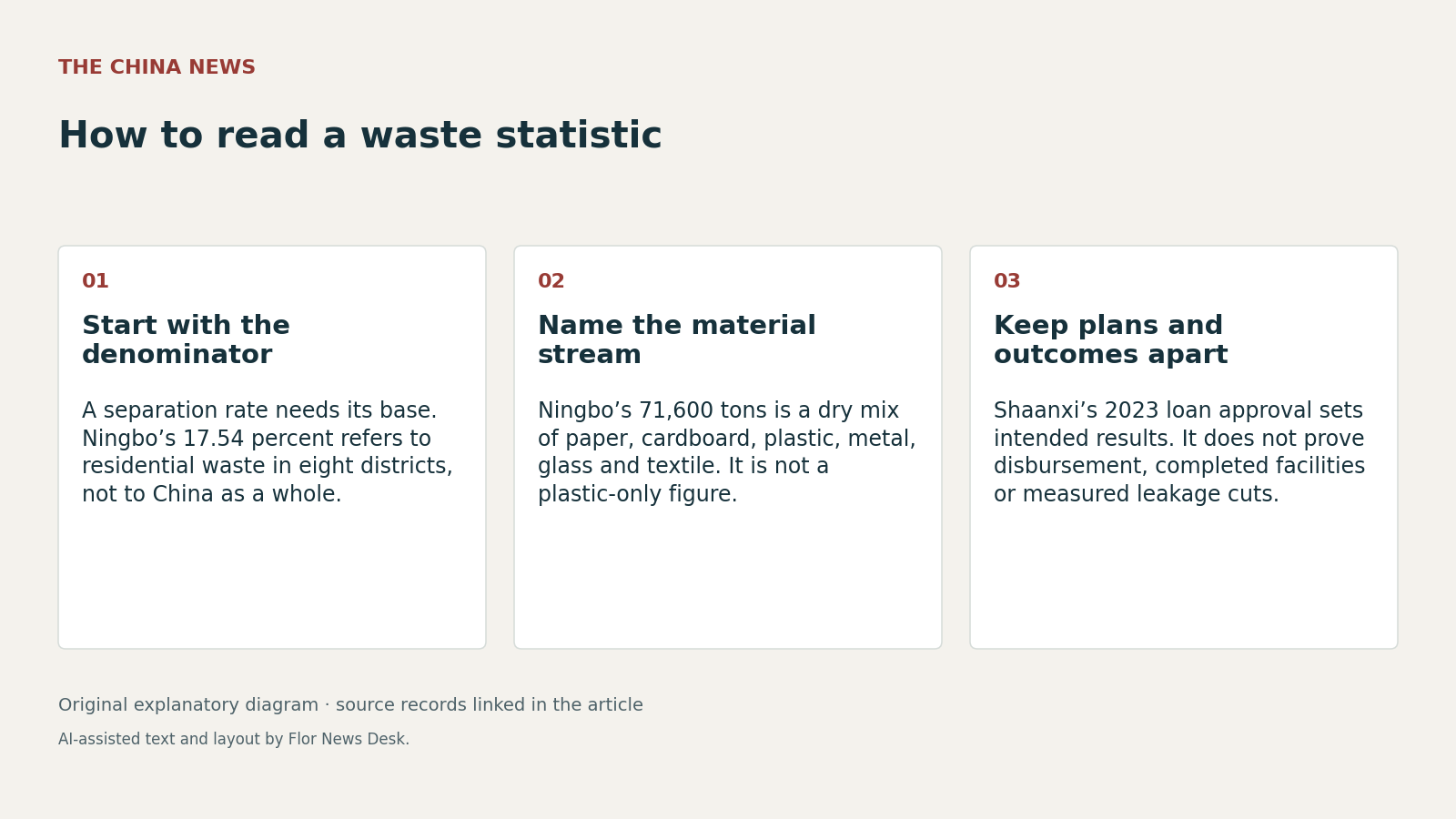
A World Bank results account of Ningbo’s waste project and a 23 March 2023 World Bank loan announcement for Shaanxi are useful for a narrower lesson than headline recycling claims. Read together, they show that any sorting statistic needs four labels attached: what waste enters the calculation, which materials are counted, where those materials go next, and when the number applies. Without those labels, a local collection figure can be mistaken for a plastic-leakage result, or a project approval can be read as a measured outcome. Ningbo results Shaanxi release
In Ningbo, the World Bank says 17.54 percent was the proportion of residential waste separated in eight participating urban districts, and that 905,000 households plus all institutional waste generators started participating. Those are not the same measure. Participation counts describe who joined; the 17.54 percent figure describes some share of residential waste in the stated districts. Neither can be restated as a national rate, and the results page does not provide the full calculation method behind that percentage. That leaves it as an institutional project result with a limited stated scope, not a free-floating benchmark. Ningbo results
The material label matters just as much. The same Ningbo record separates kitchen waste from dry recycling materials. By 2020, it attributes 193,200 tons a year to separated kitchen waste and 71,600 tons a year to a dry stream defined as paper, cardboard, plastic, metal, glass and textile. Because plastic is only one component of that dry mix, the 71,600-ton figure cannot be turned into a plastic-only result. It also should not be blended with the kitchen-waste figure as if both described one uniform recycling stream. Ningbo results
Destination is the next missing label in many waste discussions. The World Bank says Ningbo’s collected kitchen waste went to a project-financed kitchen-waste treatment factory, while separated dry recyclables went to recycling facilities respectively. That is more specific than simple collection, but it still does not establish how much material was finally recycled, rejected, landfilled, incinerated or leaked. A collection stream and a treatment destination are stages in a material flow, not proof of identical end results. The Ningbo page therefore supports claims about separated collection and stated destinations, not about plastic leakage or ultimate recovery rates. Ningbo results
The Shaanxi document shows why period and geography must stay attached. On 23 March 2023, the World Bank said its Board of Executive Directors approved a US$250 million IBRD loan for reducing plastic pollution from municipal solid waste and agricultural plastic film in rural areas of Shaanxi Province, with the Shaanxi Development and Reform Commission leading implementation. The release says the project will support planning, financing, treatment facility development, stakeholder engagement, performance evaluation, regulation and institutional capacity, while presenting reduced leakage and better collection and treatment as intended results. That is a project-approval record, not a completion report, and it does not show disbursement, built facilities or measured leakage reductions. Shaanxi release
Set beside Ningbo, the Shaanxi announcement is best read as a scope contrast, not a scorecard. Ningbo’s figures concern mixed municipal streams in eight urban districts during a 2013-2020 project; Shaanxi’s 2023 approval concerns rural municipal waste plus agricultural plastic film. Analysis: two projects can report the same tonnage and still describe different interventions if one counts mixed dry recyclables and the other targets film alongside rural waste. One more timeline caution follows from the Ningbo page itself: its mention of a charging policy expected in 2021 is only a past expectation when read on 21 September 2026, not evidence that adoption occurred. Ningbo results Shaanxi release