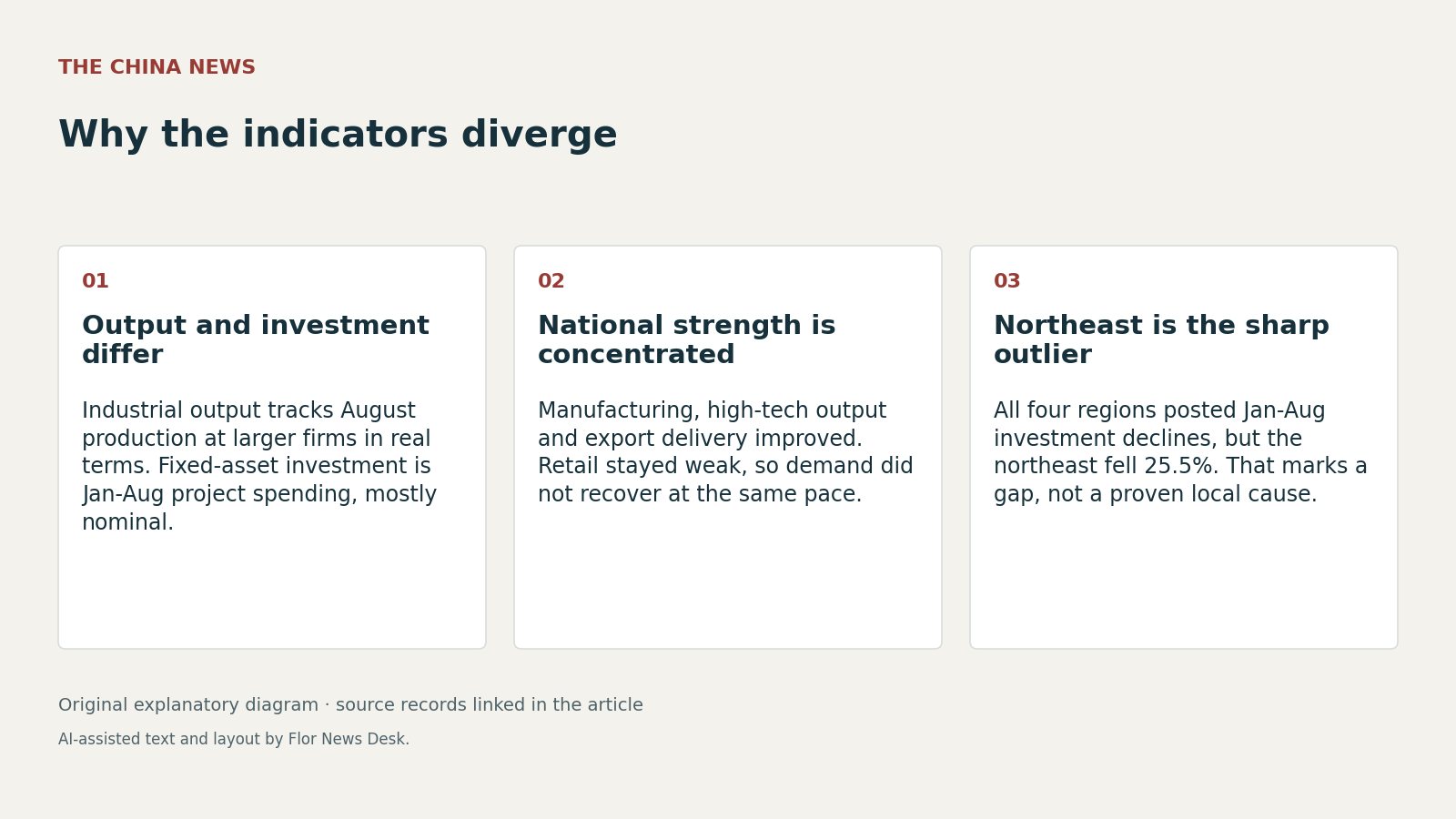

China’s August 2026 data looked contradictory at first glance. In releases dated Sept. 16, 2026, the National Bureau of Statistics of China said value added of industrial enterprises above the designated size rose 5.2% year on year in August in real terms, with manufacturing up 6.1%. In a separate release, the bureau said national fixed-asset investment excluding rural households fell 7.2% in January-August, including a 25.5% drop in the northeastern region. (Industrial output, Fixed-asset investment)
The first reason both can be true is measurement. The industrial series is an August output reading for enterprises above the designated size, defined by the bureau here as firms with annual main business revenue of 20 million yuan or more, and its headline growth rate is adjusted for prices. The investment series is different on all three counts: it is cumulative for January-August, covers projects with planned investment of 5 million yuan or more plus all real-estate development projects, and its table growth rates are not adjusted for prices. (Industrial output, Fixed-asset investment) A stronger month for factory production therefore does not, by itself, show a turn in broad capital spending.
The second reason is that the firmer national picture is narrow. The same industrial release pointed to manufacturing and selected external-demand channels rather than a general revival: high-technology manufacturing value added rose 16.7% in August, and export delivery value for industrial enterprises above the designated size rose 11.1% in nominal terms. (Industrial output) Retail data were much softer. The statistics bureau said total retail sales rose 0.4% in August and 1.1% in January-August, and that August sales by enterprises or units above the designated size fell 3.7%. (Retail sales) That combination fits a production recovery led by particular industries better than a broad-based demand rebound.
The regional investment line matters because the weakness was nationwide, but the northeast was markedly worse. The bureau reported January-August fixed-asset investment declines of 9.4% in the eastern region, 8.7% in the central region, 8.8% in the western region and 25.5% in the northeastern region. It also said industrial investment fell 2.9%, manufacturing investment fell 2.3%, infrastructure investment fell 4.0% and non-governmental investment fell 10.1%, while investment in intellectual property products rose 9.2%. (Fixed-asset investment) The bureau also warns that cross-regional investment affects comparability between regional and national growth rates, so the figures identify a clear outlier but do not, on their own, establish the exact local mechanics.
July 2026 World Bank statements make that split legible in a wider policy debate. On July 7, the World Bank said China’s economy had remained resilient in early 2026 with support from strong high-tech investment and exports, while weaker domestic demand, property-sector adjustment and cautious consumers still weighed on growth. (China Economic Update) On July 23, the World Bank Group said its new Country Partnership Framework for China for 2026-2031 would focus on productivity-led growth and jobs, human capital and social protection, and more selective, targeted financing. (Country Partnership Framework) Those are institutional assessments from July, not proof of August outcomes, but they align with a pattern in which output can improve before domestic demand and regional investment do.
What the available record does not show, as of Sept. 22, 2026, is which northeastern provinces, sectors or financing channels drove the 25.5% fall, or whether employment and household conditions moved in step. The August industrial rebound is therefore best read as evidence of stronger production in parts of the economy, not as proof that China’s rebalancing has become geographically even or demand-led. The next factual test is provincial detail, not a bigger national headline.