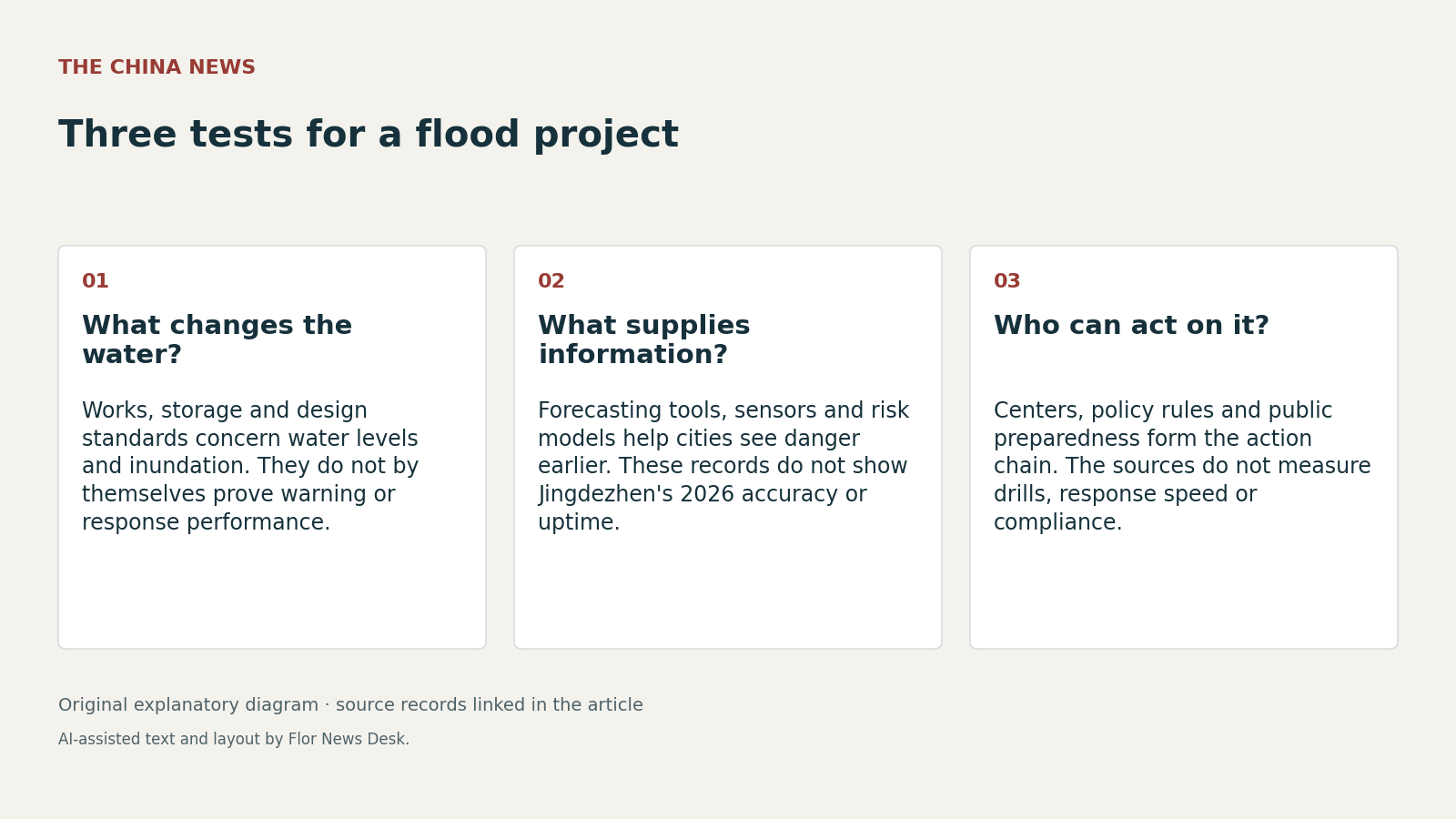
In Jingdezhen, Jiangxi, the most useful question is not whether a flood-resilience project included concrete works. It is what kind of problem each claimed result actually addresses. The World Bank’s June 23, 2021 results page on the city describes structural works, forecasting tools and preparedness measures in one project record, while a January 26, 2026 World Bank overview describes urban flood resilience as a mix of gray infrastructure, green infrastructure and non-structural measures such as planning, early warning and policy reform (Jingdezhen results page, 2026 overview). Read together, those records suggest three separate tests: what changes the movement or storage of water, what supplies information, and who can act on it.
The first test is hydraulic. The Jingdezhen page says the Jiangxi Wuxikou Integrated Flood Management Project raised the city’s flood protection standard from a 20-year to a 50-year level, increased the share of urban residents protected from 30 percent to 80 percent, and reduced the area subject to inundation under a 50-year flood from 35.58 square kilometers to 3.56 square kilometers over 2013-2020 (Jingdezhen results page). Those are claims about design standards and modeled or reported exposure. They matter, but they are not the same as proving how warnings are generated or how residents respond. They also do not amount to a promise that flooding cannot occur.
The second test is informational. The same Jingdezhen record says the project included a master plan, a Flood Control and Dispatching Center, a Decision Support System for forecasting and early warning, and public awareness activities (Jingdezhen results page). The 2026 overview broadens that category by saying the World Bank’s urban flood work also uses risk assessments to model hazard, exposure and expected annual damages, and it gives examples elsewhere of real-time sensors in Can Tho and impact-based forecasting in Tunisia (2026 overview). The analytical point is that better information can improve timing and targeting without itself moving a drop of water. These sources, however, do not provide accuracy rates, false-alarm data, maintenance records or a September 21, 2026 operating check for Jingdezhen’s system.
The third test is organizational: who can act on the information, and under what rules. A dispatching center only matters if reservoir operators, city departments and communities can translate forecasts into decisions. The Jingdezhen page points to public preparedness alongside the control center, while the 2026 overview places policy reforms and municipal capacity-building in the flood-resilience toolkit (Jingdezhen results page, 2026 overview). That means evidence for this layer would look different again: operating protocols, drills, response times or after-action reviews. None of that is established in these two records.
The July 2020 flood season shows why the distinctions matter. The World Bank says reservoir operation informed by the Decision Support System reduced peak water levels by 1.2 to 1.4 meters and that avoided losses were estimated at RMB 3.264 billion (Jingdezhen results page). Even taken at face value, that is a historical institutional estimate tied to one period, not independent proof of general performance, not measured cash received, and not evidence of current readiness in 2026.
For readers, the practical value is a cleaner way to evaluate official project claims. If a document highlights embankments, storage or protection standards, it is making a water-control claim. If it highlights models, sensors or early warning, it is making an information claim. If it highlights preparedness, dispatching or policy reform, it is making an action claim. Jingdezhen’s record is useful precisely because it contains all three categories. What it does not provide, as of September 21, 2026, is an independently verified update on how each category is performing now.