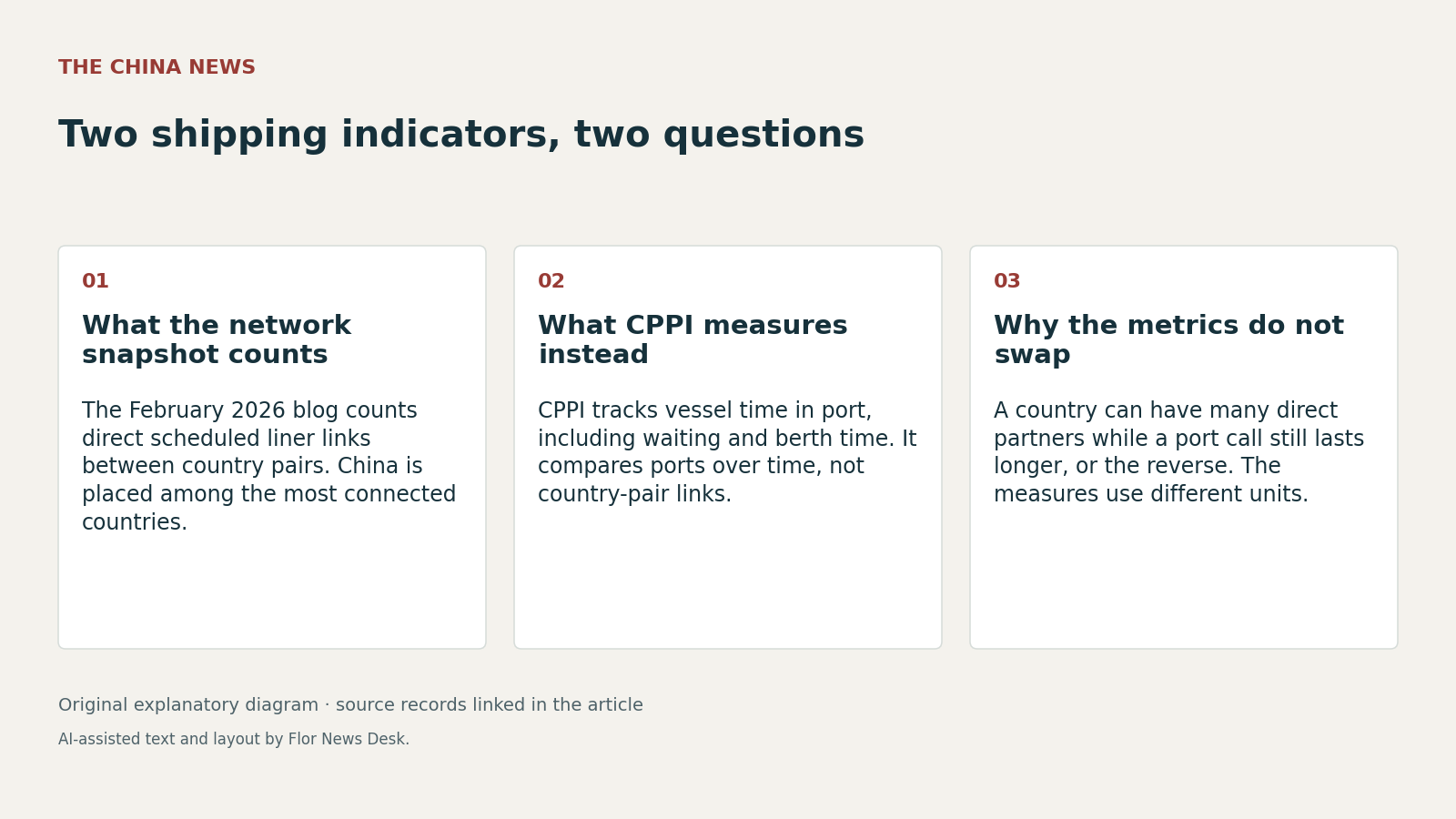
A February 25, 2026 World Bank Data Blog analysis places China among the countries with the most direct scheduled liner-shipping partners in an early-2026 network snapshot, but that finding does not answer a separate question about how long ships spend at a Chinese port call. The distinction matters because the blog and the Container Port Performance Index, or CPPI, are built to measure different things, even though both appear on World Bank platforms (network blog; CPPI overview).
The network blog by Jan Hoffmann and Antonella Teodoro compares two snapshots of scheduled container services, one from early 2006 and one from early 2026 (network blog). In that framework, countries are the nodes, a direct bilateral liner service is the connection, and the number of shipping lines on that route is the connection’s weight. The article says Spain ranks first in 2026 by direct partners, followed closely by the United States, China and the Netherlands, but the retrieved prose does not give China’s exact partner count. So the evidence supports a point about China’s position in a country-to-country service map, not a precise Chinese total and not any verdict on port operations.
The CPPI overview page describes a different unit of analysis. It presents the index as an annual benchmark by the World Bank and S&P Global Market Intelligence based on vessel time in port, including both waiting time and time at berth (CPPI overview). That means its basic question is about the duration of a ship visit at a port, not about how many foreign countries a national liner network reaches directly. The retrieved page available on September 21, 2026 describes the 2025 edition and says an updated methodological note applies from 2024 onward, but the page text shown in the brief does not carry an explicit publication date. It should therefore be read as a standing programme explanation, not as a dated September 2026 ranking release.
Once the units are separated, the logic becomes clearer. A country-pair connection is a network relationship: it asks whether scheduled direct liner services link one country to another, and how many lines serve that pair (network blog). A port-call duration is an operational time measure: it asks how long a container ship spends in a port visit, including queueing and berth time (CPPI overview). Those are not interchangeable. As a hypothetical example, a country could have direct services to many partners while one of its ports still records lengthy vessel stays, or a port could post shorter stays without implying that the country has added direct overseas connections.
The sources also set limits on interpretation. The CPPI page says results should be read in context because supply-chain disruptions, route changes, weather events and geopolitical developments can affect rankings (CPPI overview). Separately, the blog discusses port performance as one factor relevant to connectivity and points readers to measures such as CPPI, but that is not the same as proving that China’s network position was caused by any particular port-time outcome (network blog). Nor do these records establish current September 2026 conditions, freight prices, cargo volumes or the standing of any named Chinese port.
For readers trying to assess China’s place in shipping, the useful first step is to ask which question they actually want answered. If the question is about the breadth of direct scheduled country links, the February 25, 2026 blog offers one kind of evidence. If the question is about the duration of a port visit, the CPPI explanation defines another. What the retrieved record does not support is collapsing those measures into a single claim about Chinese maritime performance.