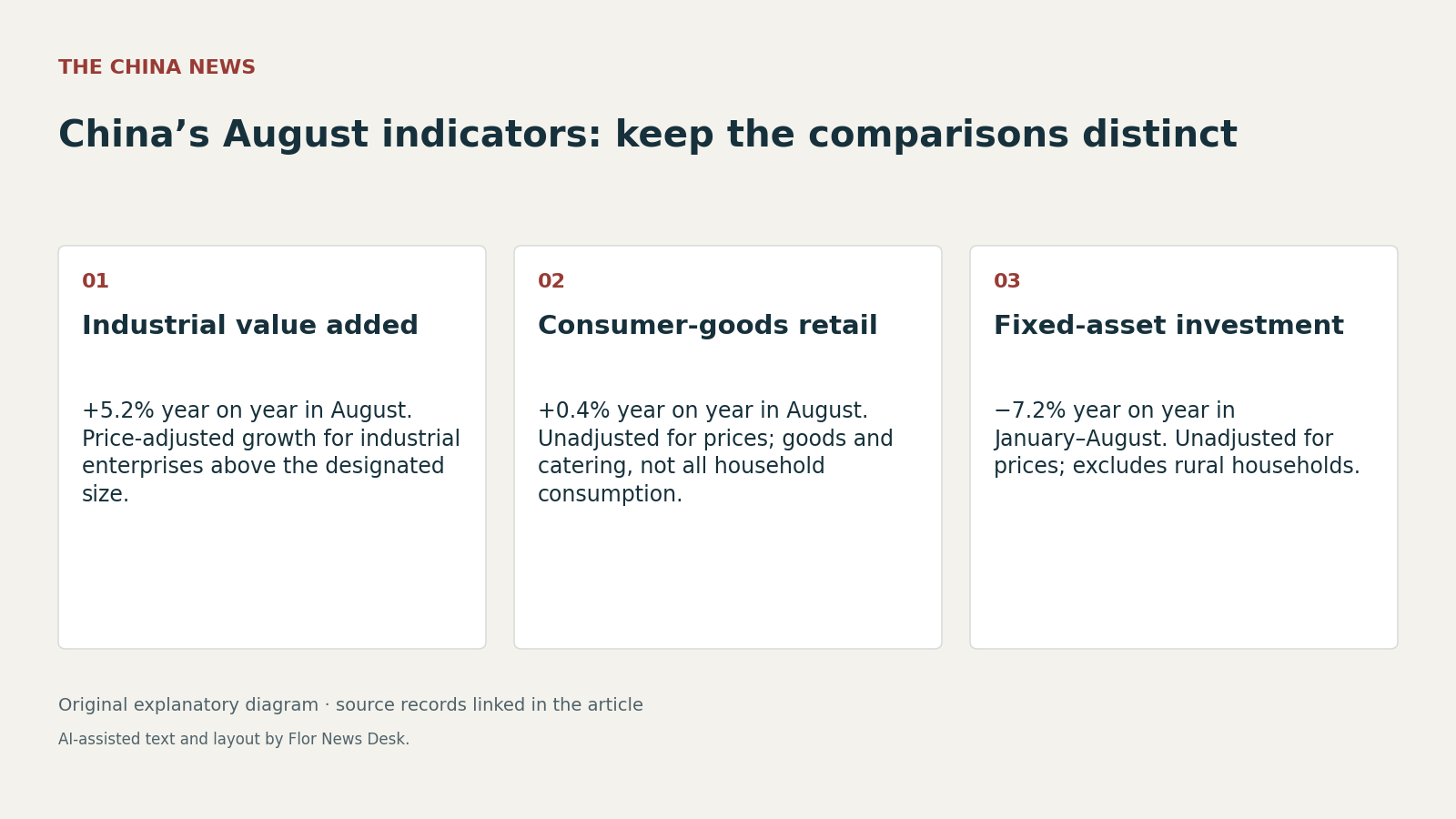
China’s August releases show stronger industrial growth alongside weaker spending. Their different definitions matter when judging the breadth of activity.
Industrial value added rose 5.2% from August 2025 after price changes were removed, according to the NBS industrial report. Manufacturing expanded 6.1%, while mining contracted 1.4%. The survey covers industrial businesses with at least 20 million yuan in annual main-business revenue.
That threshold matters. The industrial result is a measure of activity within a defined business population; it cannot establish how every small manufacturer performed. Nor does rising output, by itself, show that producers improved their margins. For a supplier assessing the market, the next useful evidence would concern the relevant industry’s orders, selling prices and payment conditions. Those questions cannot be answered by applying the national output rate to an individual company.
Spending needs its own comparison
The retail release records August consumer-goods sales growth of 0.4% from a year earlier. Excluding automobiles, growth was 2.5%. These figures retain price effects, unlike the industrial growth measure. The retail definition covers physical consumer goods and catering; it is not a complete account of household consumption.
The distinction changes the interpretation. Subtracting 0.4 from 5.2 would produce an arithmetic gap, but would not quantify an excess of physical production over purchases. Price treatment and coverage differ. Establishing such an imbalance would require matched evidence about the same products, destinations and periods. For a hypothetical example, a larger physical volume can coincide with a lower sales value when prices fall. That hypothetical is not a reported Chinese outcome.
The motor-vehicle exclusion shows why one retail headline cannot describe demand across businesses. It does not establish why purchases changed or whether a policy caused the change. Claims about consumer confidence need evidence about confidence, rather than treating sales as a substitute.
Investment covers a longer window
Fixed-asset investment, excluding rural households, fell 7.2% in January–August compared with the same period of 2025. The published rates are not adjusted for prices. Within the total, equipment and instrument purchases rose 9.3%, while construction and installation fell 9.8%.
This is an eight-month comparison, so it should not be described as an August-only collapse. Its components also warn against treating all capital spending as moving together. Rising equipment purchases and falling construction describe a changing composition of investment, not a uniform decision by every business.
The bureau says it revised the previous year’s investment base to maintain comparability. Reconstructing a growth rate from an older release’s unrevised total could therefore yield a different answer from the current official series.
The test of broader improvement is whether relevant spending and investment measures strengthen over time. These releases describe different movements; they do not establish a common cause or predict the next reporting period.