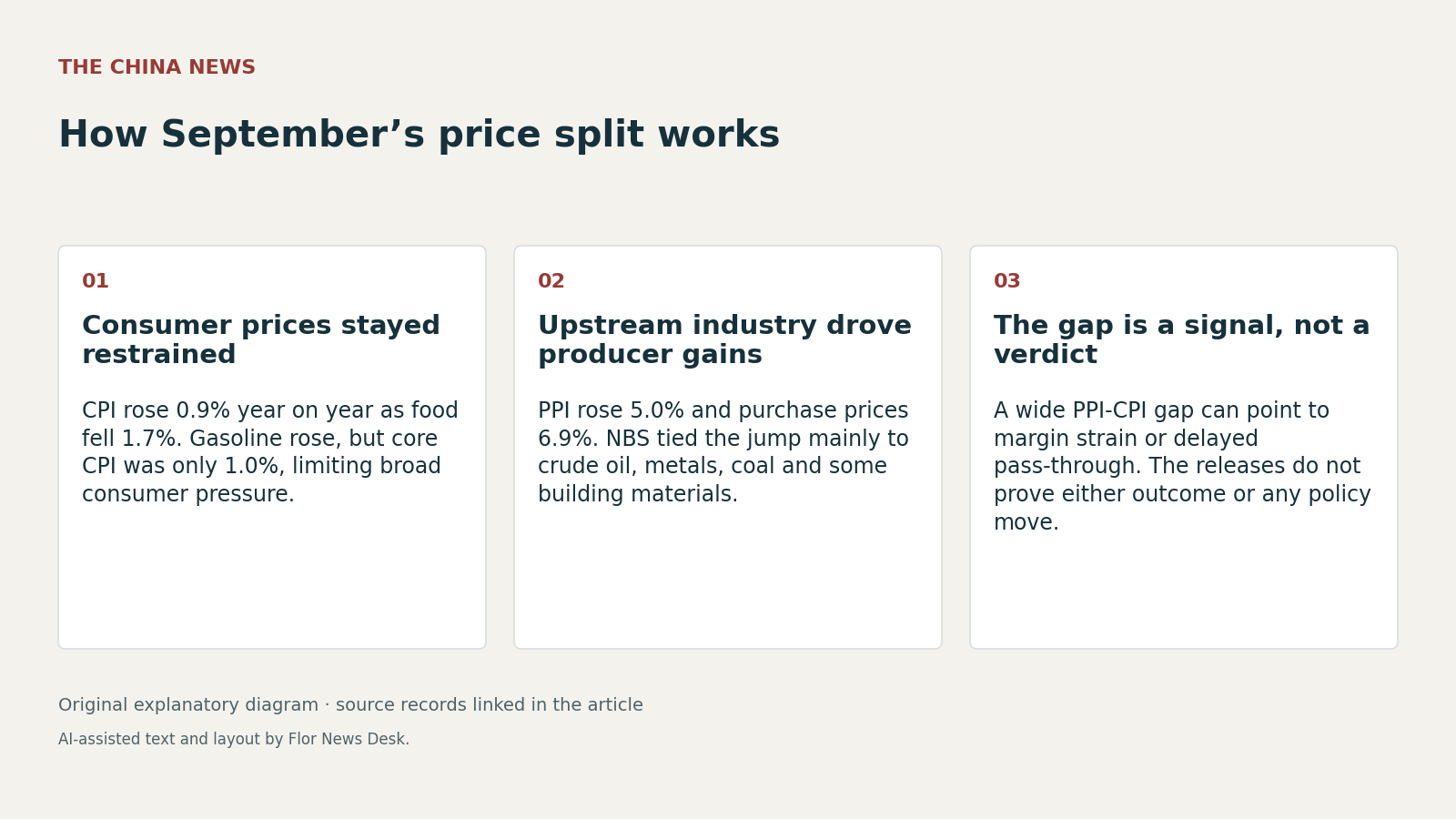

China’s National Bureau of Statistics released its September 2026 price data on 14 October, showing a familiar but sharper split: consumer prices rose 0.9% from a year earlier and 0.2% from August, while producer prices at the factory gate rose 5.0% year on year and 1.2% month on month. The same day’s releases also showed core CPI, excluding food and energy, up 1.0% year on year, and industrial producer purchase prices up 6.9% year on year. That combination matters because it suggests stronger price pressure in upstream industry than in household-facing inflation. CPI release PPI release
The official records show how those two stories can coexist. On the consumer side, September food prices fell 1.7% from a year earlier, while non-food prices rose 1.5%. In its explanatory note, the bureau said gasoline prices rose 16.6% year on year and added about 0.47 percentage points to CPI, but falling food prices subtracted about 0.29 points. That helps explain why headline CPI rose without turning into broad consumer inflation: energy-related pressure was partly offset elsewhere in the basket, and core CPI remained moderate. CPI release NBS interpretation
On the producer side, the official explanation is much more concentrated in industrial inputs. The NBS interpretation attributed part of the September month-on-month PPI rise to higher international crude oil and non-ferrous metal prices, saying five related industries together added about 0.63 percentage points. It also said coal and some building-material sectors added about 0.38 points, while electrical machinery and electronics prices were lifted by demand linked to artificial intelligence and “算电协同”. The underlying release points in the same direction: producer goods prices rose 6.5% year on year, while living materials fell 0.1%; mining prices rose 25.4%, raw materials 9.4% and processing 3.4%. NBS interpretation PPI release
That pattern is why the September gap should be read first as a distribution issue inside the economy, not as a single inflation verdict. If purchase prices rose 6.9% while ex-factory prices rose 5.0%, some firms could face input costs rising faster than their selling prices. But that is an analytical possibility, not a measured outcome in these releases. The official pages do not provide firm-level margin data, contract terms, export prices or evidence of how much cost pressure companies actually passed on. PPI release NBS interpretation
The same caution applies to exports and policy. A wider PPI-CPI gap can matter for exporters because upstream costs may rise before final selling prices do, but the September records do not establish whether Chinese exporters absorbed those costs, passed them through, or offset them in other ways. Nor do the releases show any monetary-policy decision. What they do show is that September’s producer-price acceleration did not yet amount to generalized consumer inflation. Even the bureau’s methodological notes point away from overreading technical changes: both the CPI and PPI releases say China shifted to a 2025 base period from January 2026, and the bureau estimated the rebasing changed monthly year-on-year readings by only about 0.06 and 0.08 percentage points on average. CPI release PPI release
An NBS release index currently lists both September price pages under 14 October 2026, alongside nearby macro publications including the September PMI release dated 30 September and the January-August industrial profits release dated 28 September. That makes the September CPI-PPI split part of a broader autumn data sequence, not a standalone signal. For now, the clearest reading from the official record is narrow: upstream cost pressures strengthened, consumer inflation stayed comparatively mild, and the size of any squeeze on margins, exports or policy choices still has to be shown by later evidence. NBS release index