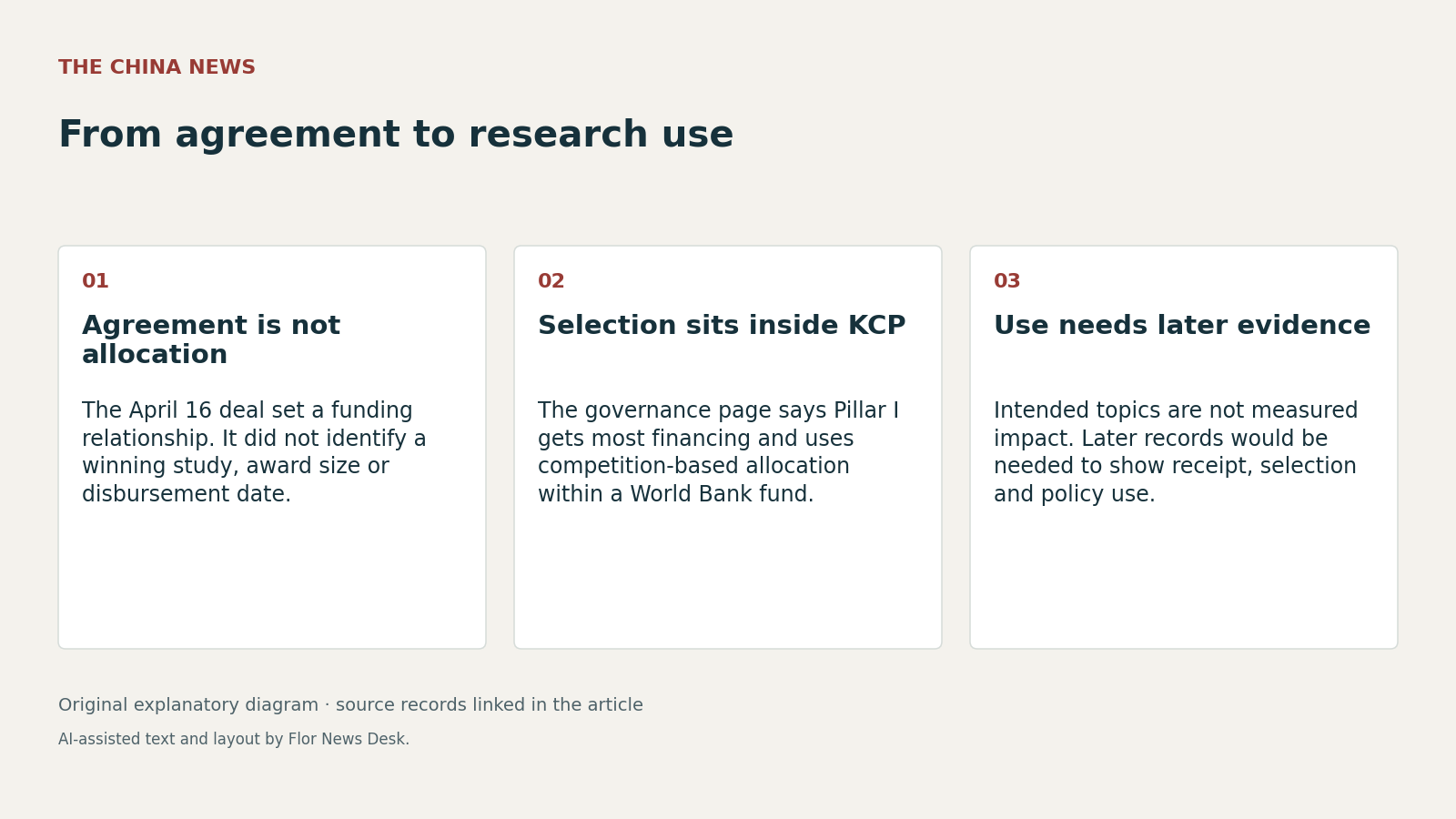
In Washington, D.C., on April 16, 2026, China’s Ministry of Finance and the World Bank signed an Administration Agreement for a planned USD3 million Chinese contribution to the Knowledge for Change Program IV Umbrella Multi-Donor Trust Fund, according to a World Bank feature published on April 20, 2026. That document establishes a funding relationship between a donor and a World Bank-managed program, not a list of winning research projects, grant sizes or completed policy results. The same feature says the money is intended to support policy-oriented research and structured engagement on topics including jobs and economic growth, digital transformation and human capital development, but intention is not the same thing as allocation or measured effect. World Bank feature
The institutional setting matters because KCP is broader than any single donor announcement. The program overview describes Knowledge for Change as an umbrella program housed in the World Bank’s Development Economics Vice Presidency and says it began operations in 2002. It groups its work under original knowledge, operational knowledge and open knowledge, and lists themes from jobs and economic transformation to technology and digital development, governance and institutions, and human capital. China appears on that page as a current partner, which shows participation in the program structure but does not identify a China-designated national project pipeline. KCP overview
The clearest available explanation of how money moves toward research selection is on KCP’s governance page. The World Bank says KCP is a World Bank-executed, multi-donor umbrella trust fund, and that Pillar I receives the majority of financing and follows a competition-based allocation process. Analytically, that means a contribution agreement and a selected study sit at different stages. One document can show that money is being committed into a pooled vehicle; another would be needed to show which proposal, if any, later won support from that vehicle. Nothing in the April 16 agreement record identifies a successful proposal title, principal team or award amount. KCP governance World Bank feature
The governance page also names the Partnership Council, Internal Management Committee and Program Management Unit. Those bodies indicate that project choice is embedded in an internal program architecture rather than settled at the signing ceremony. But the source record stops short of the details readers would need to track China’s 2026 money into a specific study: there is no decision date, no meeting record, no allocation table and no project roster tied to this contribution. The same page links to calls for proposals from 2021, 2022 and 2023, which shows historical competitions existed, but those links are not evidence of a live 2026 call or of awards made after China’s April 2026 agreement. Its wording that Pillar I “will” use competition-based allocation is also undated and could be stale by September 21, 2026. KCP governance
That leaves three separate evidence questions. First, was the contribution agreed? Yes, according to the April 20 feature describing the April 16 signing. Second, has the money been transferred or disbursed into specific work? The records provided here do not say. Third, did any funded research later change World Bank operations or government policy? The records do not establish that either. The distinction is important because the World Bank’s intended topics for the contribution are not the same as selected studies, and selected studies would still not by themselves prove later policy use. World Bank feature KCP governance
One more date point matters. The KCP overview page lists the China contribution item in its highlights with an August 12, 2026 label, but that does not establish a second signing or a fresh August agreement when the feature itself is dated April 20 and describes the ceremony as April 16. As of September 21, 2026, the available World Bank pages support a narrow conclusion: China committed to fund a World Bank research vehicle, and the vehicle’s design includes competition-based selection for its main financing pillar. They do not yet let readers map that commitment to a named project, a payment date or a verified policy outcome. KCP overview World Bank feature