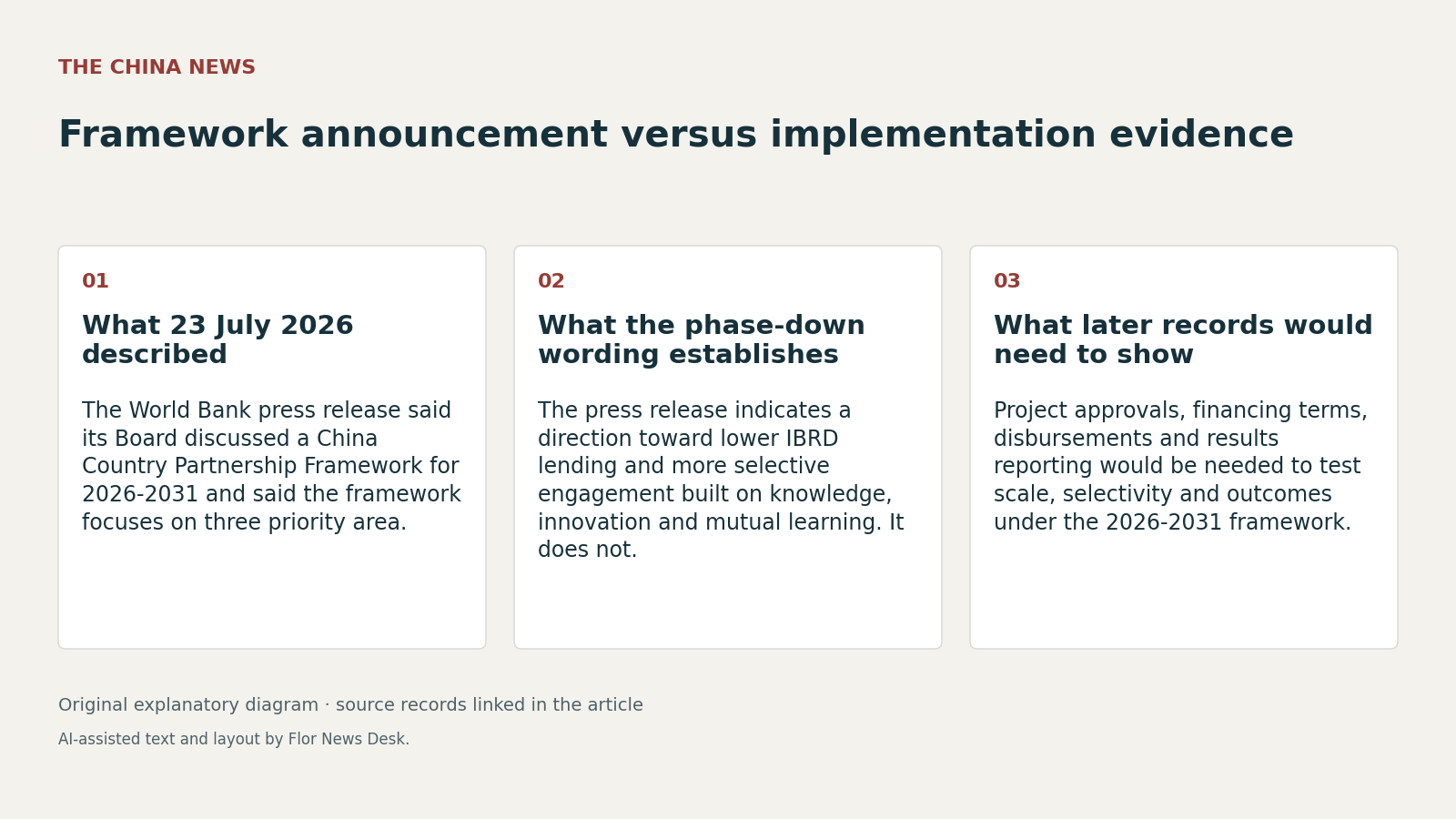
On 23 July 2026, the World Bank said its Board of Executive Directors discussed a new Country Partnership Framework for China for 2026-2031. The press release says the framework focuses on three priority areas: productivity-led growth and better jobs; human capital and social protection in response to demographic change; and resilient, sustainable infrastructure with protection and restoration of natural ecosystems. That is a useful signal about intended areas of engagement, but it is not the same as a list of approved projects or delivered outcomes. World Bank press release, 23 July 2026
The most consequential line for readers is the financing shift. The same press release says China’s relationship with the World Bank Group has evolved “from primarily financing toward a more selective engagement built on knowledge, innovation, and mutual learning,” and adds that lending from the International Bank for Reconstruction and Development, or IBRD, “phases down.” That establishes direction, not pace. The retrieved record does not provide a lending ceiling, an annual schedule, a final endpoint, a project pipeline, or transaction-level terms. World Bank press release, 23 July 2026
That distinction matters because a country partnership framework is a strategy document, not a project ledger. Even where the press release names priority areas, it does not identify which ministry, province, state entity or sector-specific operation will receive support, in what amount, or under what safeguards and borrowing terms. A later infrastructure project, for example, could still differ sharply from another project under the same umbrella in size, borrower, instrument and policy purpose. The July 2026 announcement leaves those implementation details open.
The press release also says that, as IBRD lending phases down, China’s development experience may be shared with other World Bank Group countries in areas such as ecosystem restoration, water and agricultural productivity, anchored in the China-WBG Global Center for Ecological Systems and Transitions. That supports a narrower point: China is being presented not only as a borrower, but also as a source of policy and project experience for other countries. It does not by itself show how much lending remains, which projects will move ahead, or what measurable effects any knowledge-sharing activity will have. World Bank press release, 23 July 2026
An undated World Bank China overview page helps explain the broader relationship, but it has clear limits. Retrieved on 21 September 2026, the page says the partnership began in 1980, that China graduated from the International Development Association in 1999 and became an IDA donor in 2007, and that China is the third largest shareholder of the IBRD. It also says the current lending program focuses on global public goods and stronger institutions, including decarbonization, environmental protection, water pollution control and prevention, biodiversity protection and pandemic preparedness. But the same page mixes data points from different periods, including 2024 poverty figures and first-half 2025 growth. That makes it background context, not proof of the framework’s implementation status as of September 2026. World Bank China overview, retrieved 21 September 2026
Just as important, the full FY26-31 framework document linked from the press release was not part of the retrieved record used here. So any claim about detailed conditions, project sequencing or enforcement mechanisms would go beyond the verified source base.
What would answer the open questions? Later project approvals, financing documents, disbursement records and results reporting. Those records would show whether the stated priorities became operations, at what scale, and with what outcomes. For now, the available evidence supports a narrower conclusion: the World Bank’s 23 July 2026 announcement describes strategic priorities and a planned IBRD phase-down, but it does not yet show the size, speed or results of that shift.
*This is an AI-assisted draft prepared from two retrieved World Bank records for editorial review, not publication. No independent reporting beyond those records is claimed.*